Put to the Test
The Definition
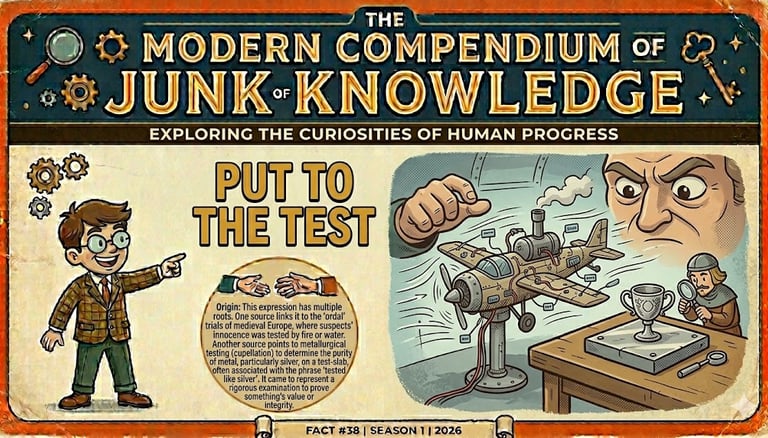
To subject someone or something to a rigorous examination or trial to determine its true quality, strength, or reliability. It is the verbal signal that the "theorizing" is over and the actual performance is about to begin.
The Deep Dive
The "junk knowledge" behind this phrase is its surprising connection to the high-stakes world of Renaissance alchemy and gold refining. While we use "test" today for school exams or software betas, the original "test" was a physical object: a small, shallow cup used to separate precious metals from dross.
The "Testa" or Cupel: In the 14th century, a test (from the Latin testa, meaning an earthen pot or shell) was a cup made of bone ash. Goldsmiths would place a sample of gold or silver into this cup and subject it to extreme heat.
The Trial by Fire: Under the intense heat of the furnace, base metals like lead or copper would be absorbed by the porous bone ash of the test, leaving behind only the pure, shining bead of precious metal. If a coin or a piece of jewelry was "put to the test," it was literally being melted down to see if it was "true" or a cheap imitation.
The Forensic Shift: By the 1500's, the term moved from the furnace to the courtroom. It became a metaphor for any process—legal, moral, or physical—that stripped away the "impurities" of a lie to find the solid "gold" of the truth.
The phrase reached peak "junk" status during the Industrial Revolution, where "testing" became a standardized part of engineering. It represents the "junk" of human nature: the cynical but necessary belief that nothing can be trusted until it has survived the most difficult conditions possible.
Fast Facts
The "Acid Test" Sibling: This is the chemical cousin of "Put to the test." It refers specifically to using nitric acid to see if a metal is genuine gold (gold does not react to the acid, but base metals do).
The Bone Ash Secret: Bone ash was used for the "test" because it is uniquely resistant to heat and highly porous, making it the perfect "sponge" for pulling impurities out of molten metal.
The Educational Evolution: The transition of "test" from a metallurgical cup to a school exam didn't happen until the late 1800's, as educators sought a word that implied a rigorous, "scientific" measurement of a student's knowledge.
References
Biringuccio, V. (1540). De la Pirotechnia. (The first printed book on metallurgy).
Ammer, C. (2013). The Dictionary of Clichés. Skyhorse Publishing.
Taggart, C. (2010). Her Who Must Be Obeyed: The Phrases and Sayings That Make Us Who We Are. Michael O'Mara Books.
The Oxford English Dictionary. (2026). Test (n.). Oxford University Press.