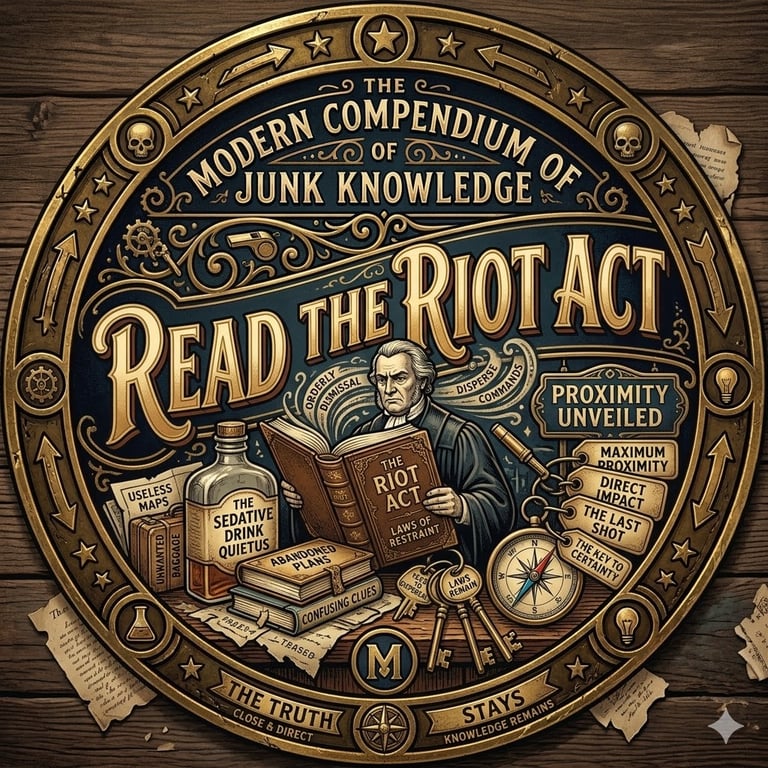
Read the Riot Act
The Definition
To give someone a stern warning or a severe reprimand. It is the verbal "final notice" before serious consequences or disciplinary actions are taken. In modern use, it usually describes a parent scolding a child or a boss dressing down an employee.
The Deep Dive
This is a literal piece of "junk knowledge" from the high-tension streets of 18th-century Great Britain. Following the accession of King George I in 1714, the country was plagued by civil unrest and Jacobite riots. The government needed a way to break up crowds without immediately resorting to a massacre.
The Law (1715): The "Riot Act" (formally the Riot Act 1714) was passed to give local magistrates the power to declare any gathering of 12 or more people an "unlawful assembly."
The Literal Reading: To enforce the act, a magistrate had to physically walk into the center of the angry mob and read a specific 115-word proclamation from a piece of paper. It began with: "Our Sovereign Lord the King chargeth and commandeth all persons, being assembled, immediately to disperse themselves..."
The "Grace" Period: Once the act was read, the crowd was given exactly one hour to leave. If they remained after the sixty minutes were up, they were officially "felons without benefit of clergy," and the military was legally authorized to use lethal force to disperse them.
The "I Didn't Hear It" Defense: Rioters would often try to drown out the magistrate with shouts and drums, claiming later in court that they never "heard the Riot Act read," which became a common (though rarely successful) legal loophole.
The phrase moved from a literal "legal reading" to a metaphorical "scolding" in the mid-1800's. It became a favorite idiom in Victorian households, where a father "reading the Riot Act" to his children meant the hour of grace was over and the "military" (the belt or the paddle) was next.
Fast Facts
The "One Hour" Rule: This is the origin of the phrase "their hour is up." If the mob didn't move within 3600 seconds of the reading, the gloves came off.
The Longevity: Believe it or not, the Riot Act remained on the books in the UK until 1967, though it hadn't been physically "read" to a crowd for decades.
The "Peterloo" Disaster: The most famous failure of the Riot Act occurred at the Peterloo Massacre in 1819, where magistrates claimed they read the act, but the crowd of 60,000 claimed they couldn't hear a word of it over the din.
References
The Riot Act 1714. (1 Geo. 1. St. 2. c. 5).
Hayter, T. (1978). The Army and the Crowd in Mid-Georgian England. Macmillan.
Ammer, C. (2013). The Dictionary of Clichés. Skyhorse Publishing.
The Oxford English Dictionary. (2026). Riot (n.1). Oxford University Press.