Red Herring
The Definition
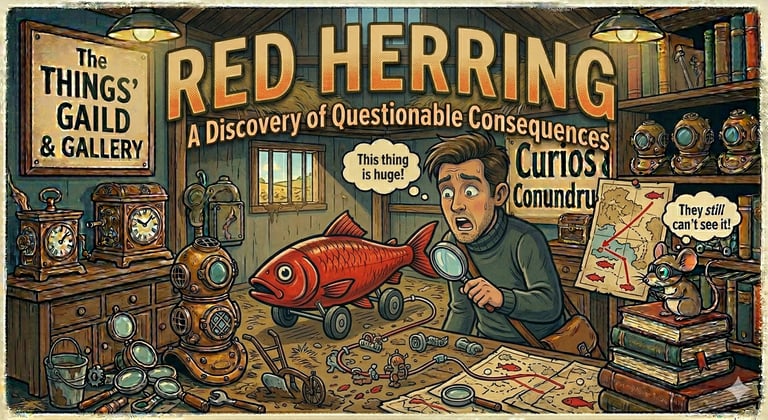
Something, especially a clue, that is or is intended to be misleading or distracting. In literature and film, it is a plot device used to lead the audience toward a false conclusion.
The Deep Dive
The most colorful "junk knowledge" story regarding this phrase claims that escaped convicts or animal rights activists would drag a pungent, smoked fish across a trail to throw bloodhounds off the scent. While a strong-smelling fish would certainly distract a dog, the actual origin of the phrase is rooted in 19th-century political journalism.
There is no such species as a "red herring." A red herring is simply a standard herring that has been heavily salted and slow-smoked for several days. This process turns the flesh a deep reddish-brown and gives it an incredibly potent, pungent aroma.
The metaphorical leap was made by the English journalist William Cobbett in 1807. In an article for his publication Political Register, Cobbett told a story about how, as a boy, he had used a red herring to lead a pack of hounds away from a hare. He used this story as a scathing critique of the English press, accusing them of following "red herrings"—false political news—that distracted the public from more important issues.
The Myth: That it was a common practice for criminals.
The Reality: It was a singular, powerful metaphor used by a disgruntled journalist that happened to stick in the public consciousness.
Before Cobbett, the term "red herring" was used almost exclusively in a culinary context or as a nickname for a soldier (due to their red coats).
Fast Facts
The Scent: The smoking process for a red herring takes about 10 days; the smell is so persistent it can linger on hands and clothing for a similar amount of time.
Literary Staple: Mystery writers like Agatha Christie became masters of the "Red Herring," often introducing a character with a shady past who turns out to be entirely innocent of the central crime.
The Dog Test: In 2010, the TV show MythBusters actually tested this; while the hounds were momentarily distracted by the fish, they eventually returned to the original scent.
References
Cobbett, W. (1807, February 14). Cobbett's Weekly Political Register. Vol. XI, No. 7.
Quinion, M. (2002). World Wide Words: Red Herring. (Online Archive).
Ross, A. S. C. (1961). The Origin of 'Red Herring'. Modern Language Notes.
Ammer, C. (2013). The American Heritage Dictionary of Idioms. Houghton Mifflin Harcourt.