Red Tape
The Definition
"Red tape" refers to excessive, rigid bureaucracy, paperwork, and official routine that stands in the way of quick action or decision-making. It represents the administrative "junk" of governance—the labyrinth of forms, permits, and redundant approvals that turns a straightforward task into a grinding, frustrating ordeal.
The Deep Dive
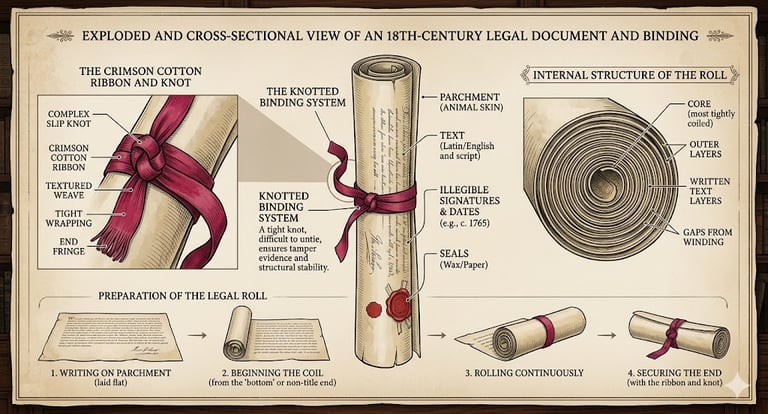
The phrase is a literal description of an archival tool used by European monarchs and bureaucrats for over five centuries to secure state secrets.
The Spanish Origin: The practice of using red binding originates in the global empire of 16th-century Spain under King Philip II. Philip was an obsessively bureaucratic ruler who managed his vast territories through an endless stream of written dossiers (consultas). To keep these massive stacks of paper organized, his administrators used red string or ribbon to bind the most critical, high-priority documents that required the King’s personal signature, separating them from ordinary matters bound in common string.
The English Importation: The custom quickly spread to England, where the Court of Chancery and the British Treasury began using a distinctive, cotton-woven red tape to bind legal briefs, wills, and state papers. For centuries, a lawyer or a citizen trying to resolve a legal dispute or access a public record had to wait for a clerk to literally untie the stubborn knots of the red tape securing the files.
The Cultural Rebrand: The phrase transformed from a description of office supplies into an insult in the 19th century. Writers like Thomas Carlyle and Charles Dickens began using "red tape" to mock the sluggish, unfeeling nature of British institutions. In his satirical essays, Carlyle attacked the government's "Red-tapism," depicting a system where officials cared more about the neatness of the ribbon binding the files than solving the actual problems of the citizens.
The Civil War Saturation: In America, the term gained widespread currency following the Civil War. Millions of veteran soldiers found themselves trapped in a seemingly infinite loop of paperwork while trying to claim their pensions from the federal government. The literal red tape binding their military records became the universal symbol of a government that had lost touch with its people.
Fast Facts
The "Pink Ribbon" Connection: Historically, the official tape used by British clerks was made of a specific dyed cotton that frequently faded to a dark pink over time. Because of this, some historical British documents are technically bound in "pink tape," though the vernacular firmly stuck to red.
Modern Regulation: In the 20th and 21st centuries, the term moved into the corporate world. Economists use "red tape costs" to calculate the exact financial burden that government regulations and compliance paperwork place on small businesses and startups.
References
Carlyle, T. (1850). Latter-Day Pamphlets. Chapman & Hall.
Dickens, C. (1853). Bleak House. (A masterful literary critique of institutional delay).
Oxford English Dictionary. (2026). The Material Culture of Early Modern Archival Administration and Bureaucracy.