Resting on Your Laurels
The Definition
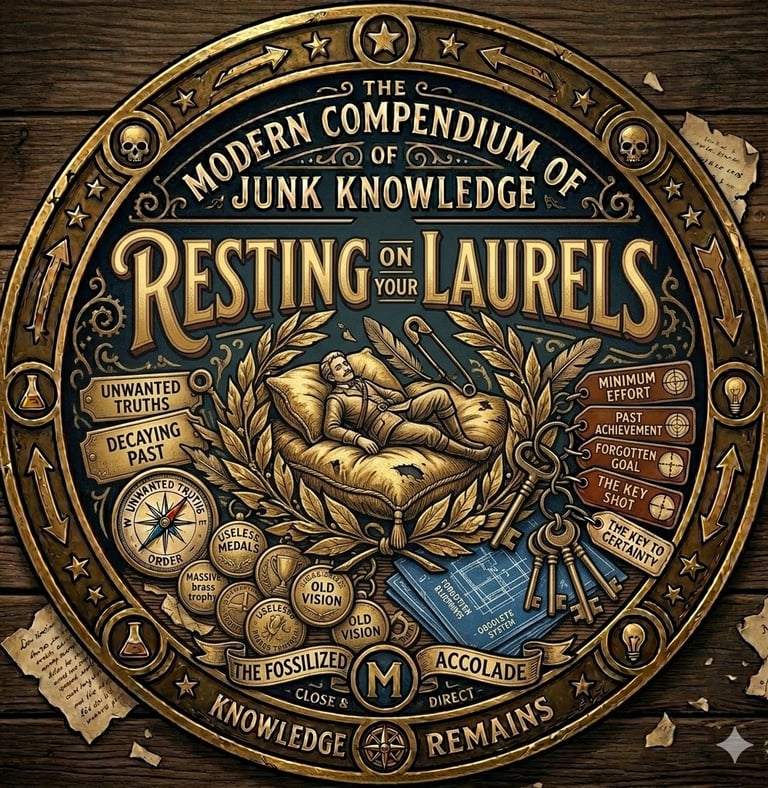
To rely on past successes instead of continuing to work or improve; to become complacent after achieving a goal. It describes someone who is "coasting" on a reputation they earned years ago.
The Deep Dive
This is a literal piece of "junk knowledge" from the high-pressure world of Ancient Greek and Roman athletics. While we now use it for a retired executive or a writer who hasn't finished a book in a decade, the origin is a physical, itchy, and highly symbolic piece of foliage.
The Sacred Tree: In Greek mythology, the laurel tree (Laurus nobilis) was sacred to Apollo, the god of light, music, and prophecy.
The Crown of Victory: At the Pythian Games (a precursor to the Olympics), winners were not given gold medals. Instead, they were crowned with a wreath of laurel leaves. To "win the laurels" was the highest honor a mortal could achieve—it was a physical manifestation of divine favor and excellence.
The "Rest" (The Sarcasm): Once an athlete or a general had won their laurel wreath, they were treated as heroes. They were often given pensions, free meals for life, and a permanent place of honor.
The Danger of the Wreath: Because the laurels represented a past achievement, a person who literally "sat down" while wearing them was seen as someone who had stopped striving. By the 19th century, the phrase became a popular English idiom to describe someone who used their "laurels" as a comfortable cushion rather than a motivation to win the next race.
The phrase reached peak popularity in Victorian England, where the "Protestant Work Ethic" made complacency a social sin. It was used by schoolmasters and military officers to remind their charges that "yesterday's victory won't win tomorrow's battle."
Fast Facts
The "Baccalaureate" Link: This is a linguistic cousin. The word "Bachelor" (as in a degree) comes from the Latin bacca lauri (laurel berry), referring to the wreaths traditionally worn by graduates.
The "Poet Laureate": This official title, still used in the UK and US today, stems from the same tradition—the idea that a poet has achieved such "laurel-worthy" status that they are recognized by the state.
The First Print: While the concept is ancient, the exact wording "to rest on one's laurels" appeared in English political speeches in the 1790's to criticize generals who stopped fighting after a single victory.
References
Pindar. (c. 470 BC). Pythian Odes. (On the crowning of victors).
Ammer, C. (2013). The Dictionary of Clichés. Skyhorse Publishing.
Brewer’s Dictionary of Phrase and Fable. (2026). Laurels.
The Oxford English Dictionary. (2026). Laurel (n.). Oxford University Press.