Right on the Money
The Definition
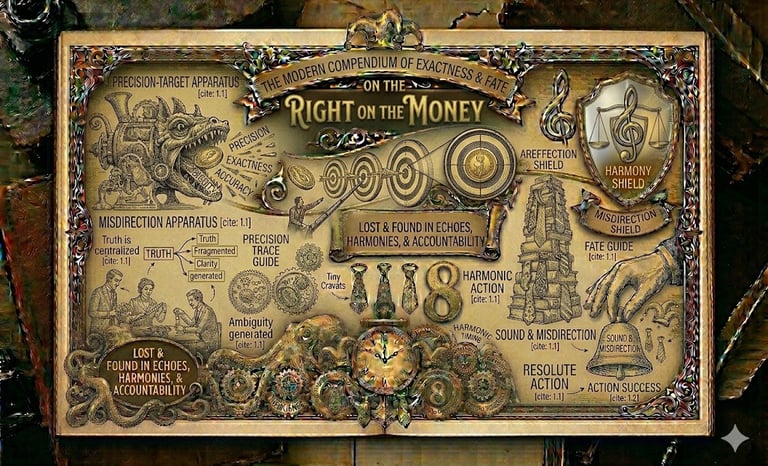
This idiom signifies that something is exactly correct, precise, or perfectly accurate. Whether it is a guess, a financial estimate, or a physical aim, being "right on the money" means you have hit the target without any margin of error.
The Deep Dive
The phrase has its roots in the high-stakes world of sports betting and marksmanship, where accuracy was directly tied to a financial payout.
The Surveyor’s Precision: One theory suggests a connection to land surveying and property boundaries. In the early 19th century, if a surveyor’s measurements matched the deeds perfectly, the valuation was "on the money." Any "coloring outside the lines" of the official record would result in a financial dispute.
The Betting Ring: The most likely origin comes from horse racing and prize fighting. In the 1800's, a "money" was a term used for a prize or a pot. If a person predicted the winner of a race exactly, their prediction was "right on the money"—meaning it aligned perfectly with the outcome that triggered the payout. It represented an alignment between a prediction and the reality of the finish line.
Marksmanship: There is also a secondary link to old shooting matches where coins were sometimes used as targets. A shooter who hit the coin directly was literally "on the money." This reinforced the idea that being right wasn't just about being close; it was about hitting the exact center of the bullseye.
Fast Facts
The "On the Mark" Rival: This is an older, non-financial variation that refers to a target or a starting line in a race. "Right on the money" adds an extra layer of value and significance to the accuracy.
"Spot On": This is the British equivalent, which likely comes from the "spot" or center of a billiards table or a dartboard.
References
Ammer, C. (2013). The Dictionary of Clichés. Skyhorse Publishing.
Ayto, J. (1990). Dictionary of Word Origins. Arcade Publishing.
Oxford English Dictionary. (2026). Precision and Valuation in 19th-Century Vernacular.