Rubber Chicken
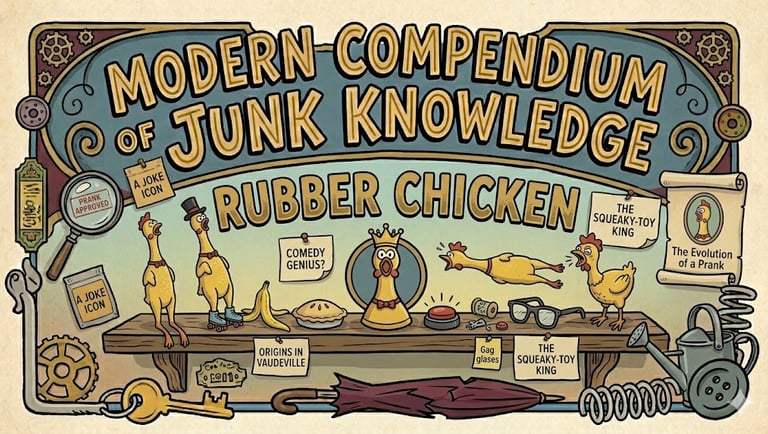
The Definition
A stylized, floppy representation of a plucked chicken made of yellow rubber or latex. It is the universal icon of low-brow comedy, physical slapstick, and "vaudeville" humor. While it serves no practical purpose, it is the go-to prop for signaling that a situation has descended into total absurdity.
The Deep Dive
The "junk knowledge" behind the rubber chicken is its surprising evolution from a medieval weapon of mockery to a mid-century industrial novelty. Long before the invention of rubber, court jesters and traveling performers used a "slapstick" (two slats of wood that made a loud noise) or a dried pig’s bladder on a stick to mock the nobility.
The Bladder Precursor: In the Middle Ages, an inflated, dried pig's bladder was used to "bonk" people on the head during festivals. It was loud, bouncy, and harmless. As the circus and vaudeville eras dawned, performers looked for a more "modern" and visually ridiculous version of this bladder-on-a-stick.
The Maxwell House Connection: The modern yellow rubber chicken we recognize today was popularized in the early 20th century. Legend (and some "junk" lore) attributes the design to a prop maker who wanted to mock the "tough, skinny chickens" served at cheap boarding houses.
The "Squawk" Engineering: While early versions were silent, the addition of the "voice box"—a simple reed that emits a pathetic, wheezing shriek when the chicken is squeezed—transformed it from a visual gag into an auditory assault. This squeak is scientifically tuned to a frequency that the human brain finds inherently "silly" or irritatingly funny.
The rubber chicken reached peak "junk" status in the 1970's and 80's, becoming the unofficial mascot of "The Gong Show" and a staple of professional wrestling gags. It represents the "junk" of the human funny bone: the primal, inexplicable fact that a floppy, dead bird made of latex is funny in almost any context, regardless of language or culture.
Fast Facts
The "Rubber Chicken Circuit": In politics and business, this phrase refers to the endless series of banquets and fundraisers where the food (usually overcooked chicken) is so generic and tough it might as well be made of rubber.
The Space Traveler: In 2012, a rubber chicken named "Camilla" was sent into the stratosphere by NASA students to study solar radiation. She wore a hand-knitted space suit, proving that the joke works even at 120,000 feet.
The World Record: There are gatherings of thousands of people who all squeeze rubber chickens simultaneously to set world records for the "largest comedic squawk," a testament to the enduring power of the prop.
References
Stearns, P. N. (2014). The History of Happiness and Humor.
Vaudeville Historical Society. (2026). From Bladders to Birds: The Evolution of the Prop.
NASA Education. (2012). The Camilla Corona SDO Mission.