Rule of Thumb
The Definition
A broadly accurate guide or principle based on experience or practice rather than theory. It is a "good enough" method for making quick estimates or decisions when precision is not required.
The Deep Dive
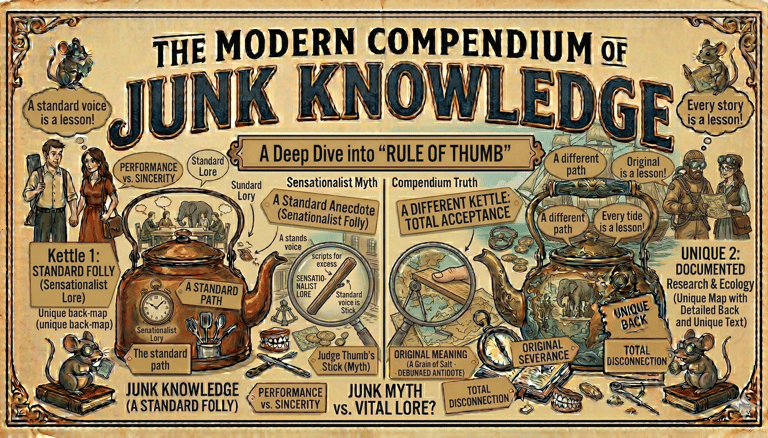
The "junk knowledge" surrounding this phrase is often dark and controversial. A widely circulated myth—popularized in the 1970's—claims the phrase originates from an old English law that allowed a man to beat his wife, provided the stick he used was no thicker than his thumb. However, legal historians have found no evidence that such a law ever existed.
The true origin is far more practical and rooted in the history of ancient craftsmanship. Before the standardization of the metric and imperial systems, the human body was the primary tool for measurement.
The Weaver’s Inch: For centuries, the width of a man’s thumb was used as a rough substitute for an inch (the word for "inch" in many languages, like the French pouce, literally means "thumb"). Weavers used their thumbs to measure the width of cloth, and brewers reportedly dipped their thumbs into vats to test the temperature of the beer.
The Carpenter’s Gauge: Carpenters and woodworkers used the "rule of thumb" for quick alignments. While it wasn't precise enough for fine cabinetry, it was perfect for rough framing or fencing where a "thumb’s width" was a consistent enough standard for the job at hand.
The phrase moved from the workshop to the written page in the late 17th century. It was famously used by Sir William Hope in 1692, who noted that "What he doth, he doth by rule of Thumb, and not by Art." By the 19th century, it had become a general metaphor for any practical, "unscientific" way of doing things.
Fast Facts
The "Inch" Connection: In the Roman system, an uncia (the root of "inch") was defined as 1/12th of a foot, which happens to be the approximate width of an adult male's thumb at the base of the nail.
The Legal Myth: The "wife-beating" legend likely stems from a 1782 satirical cartoon of Judge Sir Francis Buller, who was rumored to have made such a ruling, though no official record of the judgment exists.
The Brewer’s Thumb: Some folklore suggests brewers used their thumbs to ensure the wort was at the correct temperature for adding yeast—if it was too hot for the thumb, it was too hot for the yeast.
References
Hope, W. (1692). The Compleat Fencing-Master.
Ammer, C. (2013). The Dictionary of Clichés. Skyhorse Publishing.
Kelly, H. A. (1994). Rule of Thumb and the Folklaw of the Husband's Stick. Journal of Legal Education.
The Oxford English Dictionary. (2026). Thumb (n.). Oxford University Press.