Run of the Mill
The Definition
Something that is ordinary, average, or unexceptional. It describes an item or situation that is standard-issue and lacks any special or distinguishing features.
The Deep Dive
While modern users might think of a "mill" as a generic factory, this phrase specifically originates from the early days of the textile and grist mills of the Industrial Revolution. It describes the raw, uninspected output of a production cycle before any quality control has taken place.
In a textile mill, the "run" was a specific batch of fabric produced during a single continuous operation of the looms.
The Grading Process: Once a "run" was completed, the fabric was traditionally sorted into grades. The finest pieces were set aside for luxury garments, while pieces with snags or uneven dyes were sold as "seconds."
The "Run" of the Mill: To buy fabric straight from the "run of the mill" meant you were taking the cloth exactly as it came off the machine—unsorted, unselected, and utterly average. It wasn't necessarily bad; it just wasn't "special."
The phrase transitioned from the garment trade to general English in the late 19th century. By the 1920's, it was being used to describe everything from a "run of the mill" politician to a "run of the mill" Tuesday—implying that the subject is exactly what you’d expect from the standard machinery of life.
Fast Facts
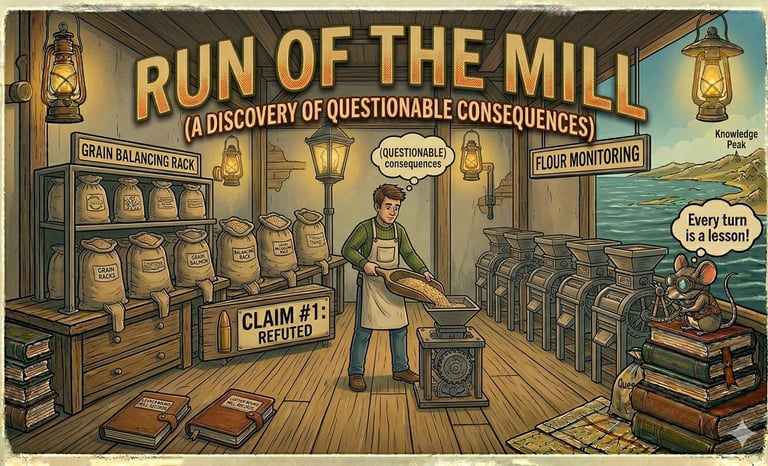
The Grist Connection: A similar concept existed in flour mills. "Run of the mill" flour was the unsifted, basic product containing both the fine flour and the coarser middlings.
The "Mine" Variation: A less common but related phrase is "run of the mine," used in the coal industry to describe ore that hasn't been sized or cleaned.
The Shift: In its earliest usage (c. 1880), the phrase was often "run-of-mine" or "run-of-kiln," but the "mill" version eventually won the linguistic popularity contest.
References
Ammer, C. (2013). The Dictionary of Clichés. Skyhorse Publishing.
Landes, D. S. (2003). The Unbound Prometheus: Technological Change and Industrial Development in Western Europe from 1750 to the Present. Cambridge University Press.
The Oxford English Dictionary. (2026). Run (n.1). Oxford University Press.
Montgomery, F. (1984). Textiles in America, 1650-1870. W. W. Norton & Company.