Running Aground
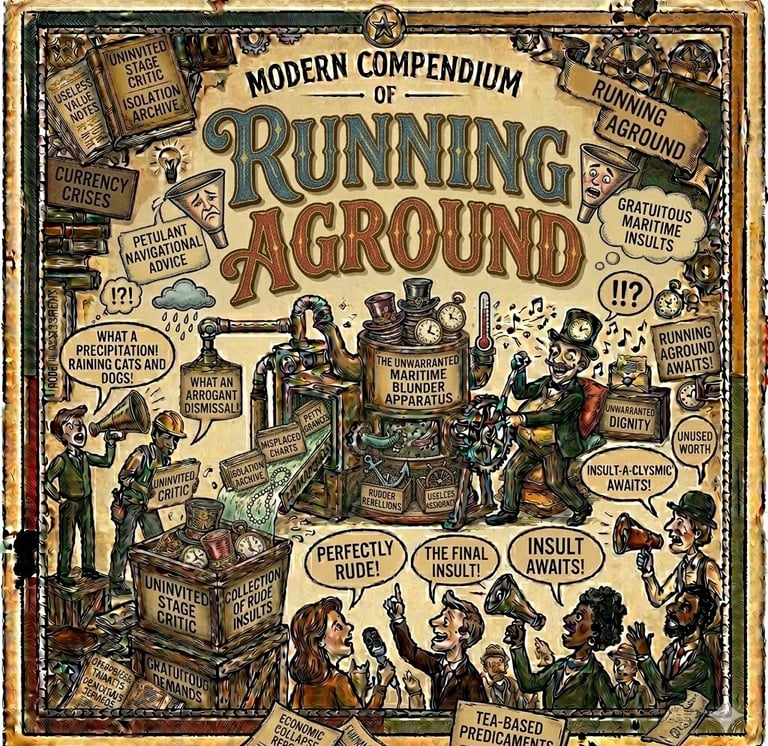
The Definition
To strike the bottom in shallow water; to hit a hidden sandbar, reef, or mudflat that brings a vessel to a dead stop. In a metaphorical sense, it describes a project, a conversation, or a career that has lost its momentum and is now "stuck" in the muck of reality.
The Deep Dive
This is a "high-friction" piece of junk knowledge from the age of wooden-hulled sail. Before the invention of sonar and GPS, the ocean floor was a jagged, invisible mystery. "Running aground" was often the first step toward a total shipwreck.
The "Lead" Line: To avoid the "ground," sailors used a "lead line"—a heavy lead weight on a knotted rope. A sailor (the "leadsman") would stand at the bow and swing the weight into the water. By feeling the knots as they slipped through his fingers, he could "read" the depth. If he called out "Mark Twain," he meant the water was two fathoms deep—just barely enough for most ships to avoid hitting the bottom. (The phrase "Mark Twain" is a specialized, archaic nautical term from the 19th-century Mississippi River steamboating era that means "mark [number] two," signifying that the water is two fathoms deep.)
The "Scouring" Risk: If a ship ran aground on a sandbar, the danger wasn't just the impact. The moving tides would quickly "scour" the sand out from under the bow while piling it up against the stern, effectively "burying" the ship in place.
The "Kedge" Rescue: To get "off the ground," sailors would perform a grueling maneuver called kedging. They would row a small boat out into deeper water, drop a heavy anchor (the kedge), and then use the ship’s windlass to physically "winch" the entire vessel off the sandbar and back into the channel.
The phrase transitioned from a maritime disaster to a general "stall" in the mid-19th century. It became a favorite of business writers and biographers to describe an ambitious person who had finally "hit the bottom" of their resources or their luck.
Fast Facts
The "Lame Duck" Link: In the 18th century, a "lame duck" was an investor who had "run aground" financially and couldn't pay their debts at the Stock Exchange.
The "Hard and Fast" Connection: When a ship is "hard and fast" aground, it means it is so deeply embedded in the ground that it won't move even with the rising tide. This is the origin of the term for a "hard and fast" rule.
The First Print: While the literal act is as old as boats, the figurative use—"the negotiations have run aground"—began appearing in British parliamentary reports in the early 1800's.
References
Dana, R. H. (1840). Two Years Before the Mast. (On the dangers of coastal navigation).
Falconer, W. (1769). A Universal Dictionary of the Marine.
Ammer, C. (2013). The Dictionary of Clichés. Skyhorse Publishing.
The Oxford English Dictionary. (2026). Aground (adv. and adj.). Oxford University Press.