Salt of the Earth
The Definition
A person or group of people considered to be of great worth, reliability, and honesty. It describes those who are unpretentious, hard-working, and the "moral backbone" of a community—the kind of people who keep the world running without asking for the limelight.
The Deep Dive
This is a "high-purity" piece of junk knowledge that traces back to the most famous sermon in history. While we now use it to describe a dependable neighbor or a dedicated teacher, the origin is a literal, chemical metaphor for preservation.
The Sermon on the Mount: The phrase was popularized by the Gospel of Matthew (5:13). Jesus, speaking to his disciples, said: "Ye are the salt of the earth: but if the salt have lost his savour, wherewith shall it be salted?"
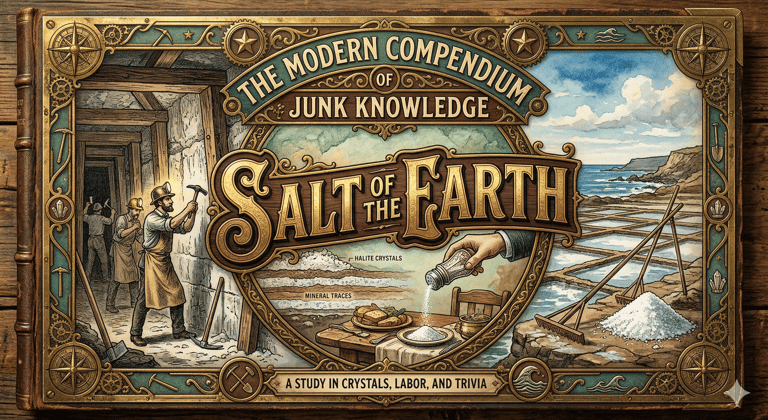
The "Junk" Reality of Ancient Salt: In the 1st century, salt wasn't the refined, white crystals we see today. It was often gathered from the shores of the Dead Sea and was full of impurities—gypsum, vegetable matter, and other minerals.
The "Lost Savour": Because it was a mixture, the actual sodium chloride (the "saltiness") could be dissolved away by moisture, leaving behind a white, gritty, but completely tasteless residue of "junk" minerals. This "salt that lost its savour" was useless for seasoning or preserving food and was literally thrown out to be "trodden under foot."
The Metaphor of Preservation: To be the "Salt of the Earth" was to be the element that prevented society from "rotting." Before refrigeration, salt was the only thing that kept meat from spoiling. A "salty" person was a preservative force—someone whose presence kept the community's values fresh and intact.
The phrase remained a religious staple for centuries but entered the general English lexicon as a secular compliment in the 14th century, appearing in Chaucer’s The Summoner's Tale. By the 20th century, it was famously used by the Rolling Stones in their 1968 song of the same name, dedicated to the "hard-working people" of the world.
Fast Facts
The "Worth Your Salt" Cousin: This is a linguistic sibling. While "Salt of the Earth" refers to your character, being "worth your salt" refers to your competence (stemming from the Roman "salarium" or salt-allowance paid to soldiers).
The "Above the Salt" Link: In medieval dining, a large salt cellar sat in the middle of the table. Important guests sat "above the salt" (near the host), while commoners sat "below the salt."
The First Print: Beyond the Bible, the phrase in its modern, idiomatic form appeared in English literature as early as 1386.
References
The Holy Bible. (King James Version). Matthew 5:13.
Chaucer, G. (c. 1386). The Canterbury Tales.
Ammer, C. (2013). The Dictionary of Clichés. Skyhorse Publishing.
The Oxford English Dictionary. (2026). Salt (n.1). Oxford University Press.