Scapegoating
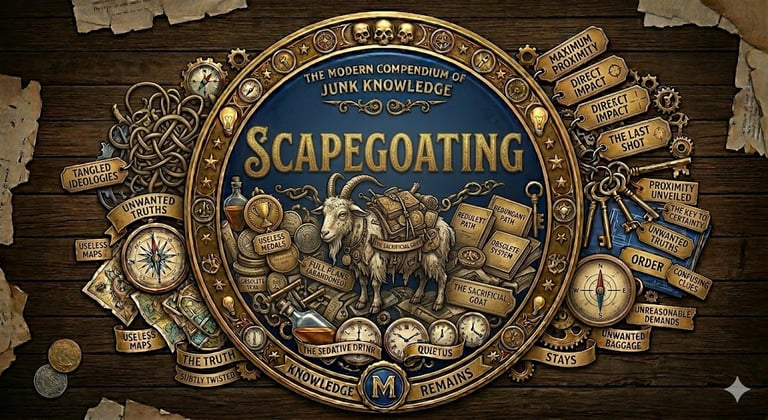
The Definition
The practice of singling out a person or group for unmerited blame and consequential negative treatment. It is a psychological defense mechanism—often used by individuals, families, or entire societies—to displace feelings of aggression, guilt, or failure onto a convenient target, thereby preserving the "purity" or "stability" of the group.
The Deep Dive
The "junk knowledge" behind scapegoating is that it is not just a metaphor; it was a literal biological ritual designed to maintain the spiritual hygiene of a community. The term originates from the Hebrew Bible, specifically the Book of Leviticus (Chapter 16).
The Ritual of Azazel: During the Day of Atonement (Yom Kippur), the high priest would take two goats. One was sacrificed. The other—the "escape goat"—had the sins of the entire community symbolically placed upon its head through a confession. The goat was then led out into the wilderness (representing the land of Azazel) and released, literally carrying the people’s sins away with it.
The Linguistic Glitch: The word "scapegoat" is actually a 1530 translation error by William Tyndale. He interpreted the Hebrew word Azazel (which likely referred to a specific place or a fallen angel) as ez ozel, meaning "the goat that departs." Hence, the "escape-goat" became the "scapegoat."
The Psychological Shift: While the ancient ritual was about purification, modern scapegoating is about displacement. In the 20th century, psychologists like Anna Freud identified it as a projection mechanism. When a person (or a government) faces a problem they cannot solve, they find a "visible" target to blame, which provides a temporary, albeit false, sense of control.
Scapegoating reached peak "junk" status in the mid-20th century as a tool for political propaganda. It represents the "junk" of social logic: the belief that complex systemic problems (like an economic depression) can be "cured" by removing a specific group of people.
Fast Facts
The "Black Sheep": While similar, a "black sheep" and a "scapegoat" are different. A black sheep is someone who is seen as a disappointment or an outlier by their own choice or nature; a scapegoat is someone who is actively burdened with the failures of others.
The Workplace Scapegoat: In corporate environments, "scapegoating" often occurs during failed projects. Research shows that "firing the coach" or the project manager is frequently a form of scapegoating used by executives to avoid addressing deeper, structural issues within the company.
The Mimetic Theory: Philosopher René Girard argued that scapegoating is the foundation of all human culture. He believed that human societies naturally build up "mimetic tension" (jealousy and rivalry) and that the only way to prevent total collapse is to unite the group in the "murder" or expulsion of a single victim.
References
Girard, R. (1986). The Scapegoat. Johns Hopkins University Press.
Tyndale, W. (1530). The Five Books of Moses (The Tyndale Bible).
Freud, A. (1936). The Ego and the Mechanisms of Defence.