Scattered to the Winds
The Definition
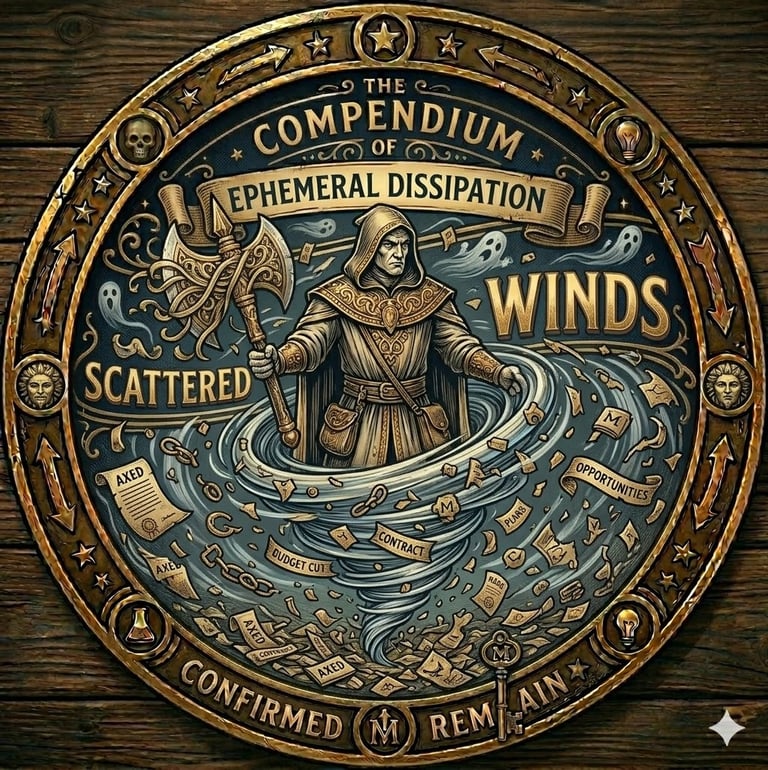
A poetic idiom used to describe something that has been completely dispersed, lost, or destroyed beyond the possibility of recovery. It evokes the image of seeds, ashes, or dust being caught in a gust of air and carried in every direction, rendering the original whole nonexistent.
The Deep Dive
The "junk knowledge" behind "scattered to the winds" is that it transitioned from a literal ancient agricultural reality to a theological threat. Before it was a cliché for a lost promotion or a messy breakup, it was a terrifying image of divine judgment.
The Winnowing Process: In the ancient world, "scattering to the wind" was the final step in harvesting grain. After the wheat was threshed (beaten to loosen the husks), farmers would use a winnowing fork to throw the mixture into the air. The "good" grain, being heavy, would fall back to the floor. The "junk"—the light, useless chaff—would be caught by the breeze and "scattered to the winds."
The Biblical Warning: The phrase appears multiple times in the Old Testament (notably in Ezekiel and Jeremiah). In these contexts, to be "scattered to the four winds" was the ultimate punishment for a nation—not just a physical exile, but a spiritual disintegration where the community could never be gathered back together.
The Four Winds: Ancient geographers and sailors recognized "four winds" corresponding to the cardinal directions (North, South, East, West). To be scattered to all of them meant there was no "home" left to return to; you were being pulled toward every horizon simultaneously.
The phrase reached peak "junk" status in the Romantic era of literature (18th and 19th centuries), as poets like Shelley and Byron used it to describe the fall of empires and the vanity of human ambition. It represents the "junk" of permanence: the reminder that everything we build is eventually subject to the "entropy" of the air.
Fast Facts
The Ash Connection: The phrase is deeply linked to the practice of scattering cremated remains. Historically, this was often done "to the winds" (or over water) to symbolize the return of the physical body to the elemental cycle of the earth.
The Military Command: In naval warfare during the Age of Sail, a fleet that was "scattered to the winds" by a storm (rather than a battle) was often more demoralized than a defeated one, as the loss of cohesion was seen as a failure of seamanship.
The 1681 Parallel: Just as the Dodo’s population was "scattered" and eventually vanished, the phrase is often used in biology to describe extirpation—when a species is wiped out in a specific geographic area but survives elsewhere.
References
The Bible. (KJV). Ezekiel 5:12, Jeremiah 49:36.
Ammer, C. (2013). The Dictionary of Clichés. Skyhorse Publishing.
Homer. (c. 8th Century BCE). The Odyssey (The Bag of Winds).