Scot-Free
The Definition
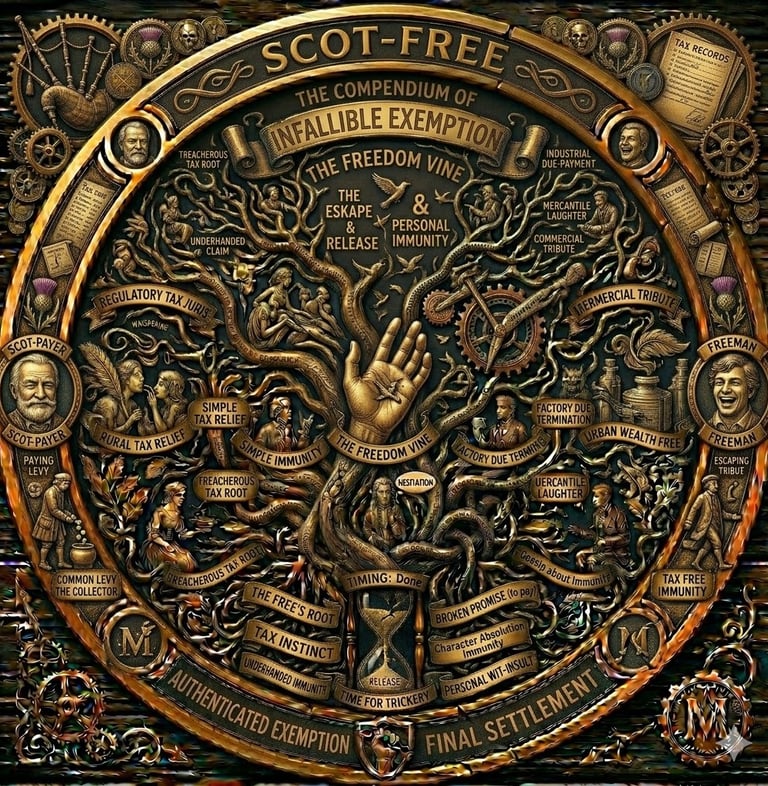
To get away "scot-free" is to escape punishment, a fine, or a consequence for an action, particularly when one's guilt is apparent. While modern usage often brings to mind a person named Scott escaping a predicament, the phrase is actually rooted in the history of taxation and communal obligation.
The Deep Dive
The term is an etymological survivor from the Old English and Old Norse systems of local governance, having nothing to do with the name Scott or the country of Scotland.
The Medieval "Sceat": The word "scot" derives from the Old English scot or sceat, meaning a tax, contribution, or payment. In medieval England, a "scot" was a municipal tax levied by local authorities to pay for community expenses, such as the maintenance of roads, the poor, or local defense.
The "Scot and Lot" System: By the 12th century, urban dwellers were often subject to a system known as "scot and lot." To pay your "scot" was to pay your share of the taxes; to pay your "lot" was to perform your share of communal labor. It was a civic duty that defined one's standing in the community.
The Tax Evader: If a person managed to avoid paying their required tax, they were said to be "scot-free." Initially, this wasn't a metaphor for escaping a crime; it was a literal description of someone who didn't contribute to the local "junk" fund for public works.
The Shift to Justice: Over the centuries, the term moved from the accounting ledger to the courtroom. By the 16th century, it was used to describe anyone who escaped any sort of penalty or deserved retribution. It captured the social frustration of seeing someone evade a burden that the rest of the "flock" was forced to carry.
Fast Facts
The "Dred Scott" Myth: A common misconception is that the phrase originated with the 1857 Dred Scott v. Sandford Supreme Court case regarding the freedom of an enslaved man. However, the phrase "scot-free" predates the case by at least 600 years.
The Drinking "Scot": In some historical contexts, a "scot" also referred to a person's share of a tavern bill. If your friends paid for your drinks and you left without spending a cent, you had truly gone "scot-free."
References
Ammer, C. (2013). The Dictionary of Clichés. Skyhorse Publishing.
Ayto, J. (1990). Dictionary of Word Origins. Arcade Publishing.
Oxford English Dictionary. (2026). The Evolution of Municipal Taxation and Civic Duty in Middle English.