Sea Monkeys
The Definition
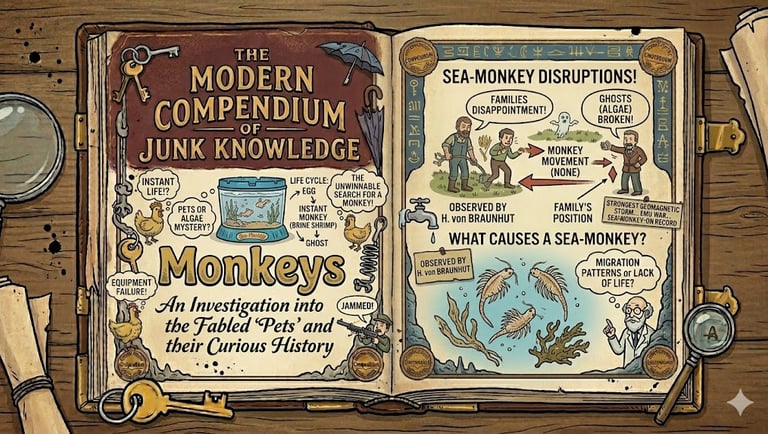
A brand name for a specialized hybrid of brine shrimp (Artemia salina) sold as "instant life" novelty pets. Packaged in dry pouches, the organisms remain in a state of suspended animation until added to water, where they hatch and grow into small, translucent crustaceans. They are the ultimate example of a product where the marketing—depicting them as a smiling, humanoid family living in underwater castles—is entirely disconnected from the biological reality.
The Deep Dive
The "junk knowledge" behind Sea-Monkeys is that they are a masterpiece of biochemical engineering and comic-book marketing. They were created in 1957 by Harold von Braunhut.
Cryptobiosis: The "magic" of Sea-Monkeys is a biological process called cryptobiosis. In their natural habitat (salt lakes), brine shrimp produce "cysts" (eggs) that can survive for years in total dehydration. When Von Braunhut discovered this, he realized he could sell "life in an envelope."
The "NYOS" Hybrid: The original brine shrimp were too small and died too quickly for children to enjoy. Von Braunhut worked with marine biologists to create a hardier, larger hybrid species called Artemia NYOS (named for the New York Ocean Science Laboratory). This hybrid grew faster and lived long enough to justify the price of a plastic "Ocean Zoo."
The Comic Book Empire: Von Braunhut’s greatest stroke of genius was hiring comic book artist Joe Orlando to draw the advertisements. The ads featured "Sea-Monkeys" that looked like happy, naked humans with long tails and crowns. This created a massive "expectation gap" for millions of children who, after weeks of waiting, realized they had actually bought a tank of "swimming specks" that looked more like insects than royalty.
Sea-Monkeys reached peak "junk" status in the 1970's and 80's, becoming one of the most successful mail-order products in history. They represent the "junk" of childhood wonder: the realization that the most boring organisms on Earth can be turned into a magical civilization if you have enough imagination—and a very good illustrator.
Fast Facts
The "Water Purifier" Trick: The Sea-Monkey kit comes with a packet labeled "Water Purifier" and a second labeled "Instant Life." In reality, the "purifier" packet contains salt and a small number of eggs, while the "instant life" packet contains more eggs and green dye. The delay between packets is just to ensure the first batch has hatched so they are visible the moment the second packet is added.
Space Travelers: In 1998, astronaut John Glenn took 400 million Sea-Monkey eggs into space on the Shuttle Discovery to see if they could survive the radiation. They hatched successfully upon return, proving they are as tough as they are tiny.
The "Monkey" Name: They were originally sold as "Instant-Life" for 49 cents. Von Braunhut changed the name to "Sea-Monkeys" in 1962 because of the shrimp's long, monkey-like tails and the playful way they seemed to "swing" through the water.
References
Von Braunhut, H. (1961). U.S. Patent No. 3,673,986: Method and Materials for Rearing Brine Shrimp.
Orlando, J. (1970). The Illustrated History of Sea-Monkey Marketing.
The New York Times. (2003). Harold von Braunhut, Seller of Sea-Monkeys, Dies at 77.