Shoot the Breeze
The Definition
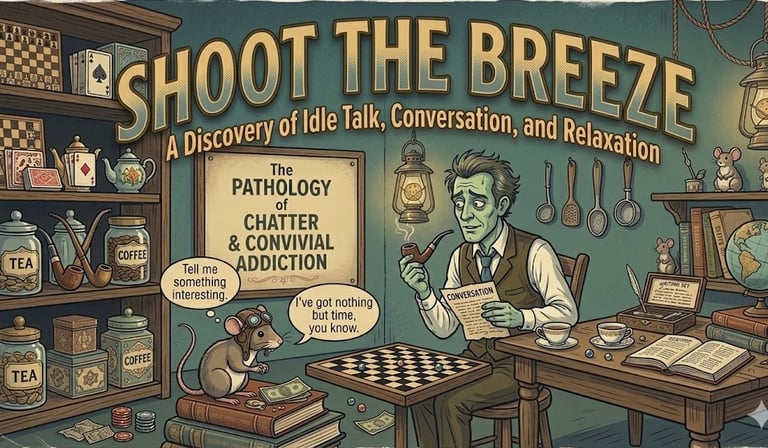
To "shoot the breeze" means to engage in idle, lighthearted conversation about unimportant topics. It describes a relaxed way of killing time through chatter that has no specific goal or "straight arrow" purpose other than social connection.
The Deep Dive
This Americanism emerged in the late 19th and early 20th centuries, rooted in the imagery of aimless activity and the vastness of the Western frontier.
Target Practice at Nothing: The phrase likely evolved from "shooting at the air" or "shooting wind," which referred to firing a gun into the sky for no reason other than to hear the noise or pass the time. In the Old West, "the breeze" or "the wind" was the only thing present in abundance. To "shoot it" was a metaphorical way of saying you were expending energy on something that offered no resistance and provided no "meat" for the table.
The "Junk" Conversation: By the 1910's, the phrase shifted from literal shooting to verbalizing. It became associated with cowboys, sailors, and soldiers—groups of people who often had long periods of downtime where the only thing to do was talk. Unlike a serious debate or a business negotiation, shooting the breeze is characterized by its lack of stakes. It is the linguistic equivalent of throwing pebbles into a pond.
Evolution from "Fan the Breeze": An earlier variation of the phrase was "fanning the breeze," which carried the same meaning of idle talk. "Shooting" eventually replaced "fanning," possibly due to the influence of other "shooting" idioms like "shooting the bull," which carried a slightly more aggressive or boastful tone.
Fast Facts
The "Shoot the Bull" Rival: While "shooting the breeze" is generally innocent and friendly, "shooting the bull" (or "shooting the sh*t") often implies telling tall tales, bragging, or lying to pass the time.
First Printed Use: The phrase began appearing in college slang dictionaries and military journals around 1910, quickly becoming a staple of American colloquial speech.
References
Ammer, C. (2013). The Dictionary of Clichés. Skyhorse Publishing.
Lighter, J. E. (1994). Historical Dictionary of American Slang.
Oxford English Dictionary. (2026). The Frontier Origins of American Idle Speech.