Show Your True Colors
The Definition
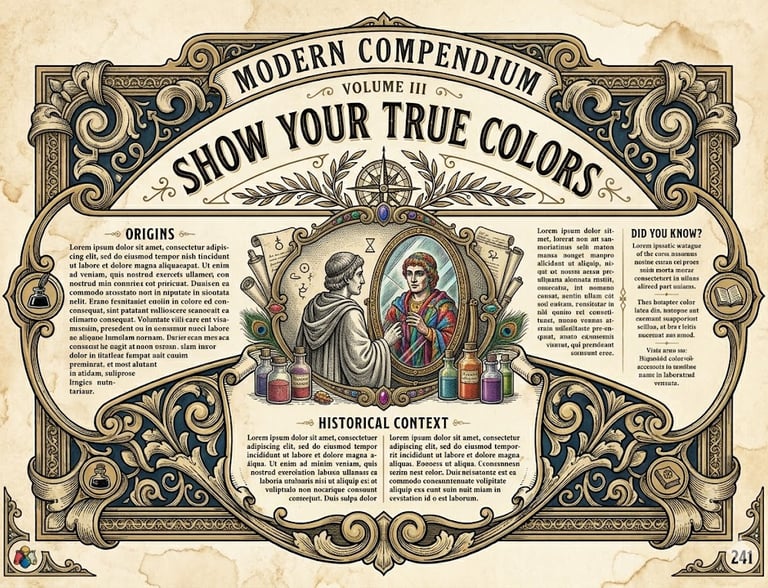
To reveal one's real character, intentions, or opinions, especially after previously hiding them or pretending to be someone else. It implies that a "mask" has been dropped, exposing the underlying reality that was previously obscured.
The Deep Dive
This is a "high-seas" piece of junk knowledge from the golden age of Age of Sail naval warfare (17th–18th century). Before the invention of radar or radio, a ship’s "colors" (its national flag) were the only way to identify it from a distance.
The "False Colors" Tactic: It was a common, and legally accepted, ruse of war for a pirate or a naval vessel to fly the flag of a neutral or even an allied nation. This allowed a predator to get within striking distance of an unsuspecting merchant ship without spooking them.
The "Law of the Sea": While you could sail under false colors, international maritime law dictated that you could not fire under them. To do so was considered "perfidy"—a war crime.
The Reveal: Just before opening fire, the attacking ship was required to lower the deceptive flag and hoist its own national ensign. This moment of raising the actual flag was the literal act of "showing your true colors."
The "Pirate" Variation: If a ship appeared friendly but suddenly hoisted the Jolly Roger (the black flag) as it pulled alongside, the victim knew the "friendly" merchant was actually a pirate. The "true colors" revealed that the situation had shifted from a peaceful encounter to a life-or-death struggle.
The phrase moved from the quarterdeck to the drawing-room in the mid-18th century. It became a favorite metaphor for writers like Tobias Smollett and Jonathan Swift to describe a "gentleman" whose polite exterior was suddenly dropped to reveal a greedy or treacherous nature.
Fast Facts
The "Nailed to the Mast" Link: This is a linguistic cousin. If a captain "nailed his colors to the mast," it meant the flag could not be lowered in surrender—the ship would fight until it sank.
The "With Flying Colors" Connection: To return "with flying colors" meant to sail back into port with your flags still high, signaling a victorious battle where the colors were never lowered or captured.
The First Print: While the naval practice is centuries old, the idiomatic use "he has shown his true colors" became a staple of English satirical literature by the 1740's.
References
Smollett, T. (1748). The Adventures of Roderick Random. (On naval life).
Jeans, P. D. (2004). Ship to Shore: A Dictionary of Pictorial Maritime Grammar.
Ammer, C. (2013). The Dictionary of Clichés. Skyhorse Publishing.
The Oxford English Dictionary. (2026). Color (n.1). Oxford University Press.