Silly String
The Definition
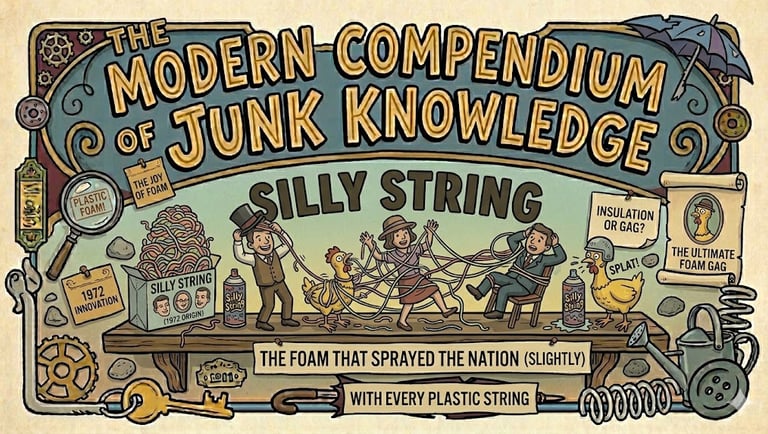
A novelty toy that propels a continuous stream of colored, aerated plastic foam from an aerosol can. Upon contact with the air, the liquid instantly hardens into a flexible, sticky string. It is the definitive "party in a can," primarily used for celebrations, pranks, and the intentional creation of temporary, colorful messes.
The Deep Dive
The "junk knowledge" behind Silly String is that it was originally conceived as a medical breakthrough. In 1972, inventors Leonard A. Fish and Robert P. Cox were trying to create a "spray-on" aerosol bandage. The idea was to produce a substance that could instantly seal a wound or provide a flexible, waterproof coating for a broken limb.
The Accidental Toy: While testing various formulas, Fish and Cox tried a nozzle that produced a long, continuous string of foam instead of a wide, flat spray. After testing it on themselves, they realized that while it was useless as a medical bandage (it was too sticky and didn't provide enough compression), it was incredibly fun to spray at people.
The Wham-O Pitch: The duo took their "instant string" to the toy giant Wham-O (the same company behind the Hula Hoop and the Frisbee). Legend has it that they sprayed the executives during the pitch meeting. The executives were initially annoyed until they realized they couldn't stop playing with the mess themselves.
The Chemical Magic: Silly String is a complex mixture of a polymer (like polyisobutylene), a plasticizer, and a propellant. When the propellant evaporates rapidly upon leaving the nozzle, it leaves behind a "solid" foam that is 90% air.
Silly String reached peak "junk" status as a staple of graduation parties and parades. It represents the "junk" of chemical serendipity: a failed medical device that found its true purpose as the world's most popular harmless weapon.
Fast Facts
The Military Utility: In a bizarre twist of fate, Silly String eventually returned to its serious roots. During the Iraq War, U.S. Marines used it to detect tripwires. Because the string is so light, it can be sprayed across a room to drape over nearly invisible wires without triggering the explosives, allowing soldiers to spot the "traps" safely.
The Birthday Ban: Several cities, most notably Los Angeles, have banned the sale or use of Silly String on Halloween. This is due to the massive cleanup costs and the fact that the dried plastic can clog storm drains and damage the paint on cars.
The Environmental Warning: Early versions of Silly String used CFCs (chlorofluorocarbons) as propellants, which were harmful to the ozone layer. Modern formulas use more environmentally friendly propellants, though the plastic string itself remains a non-biodegradable "junk" of the modern era.
References
Fish, L. A. & Cox, R. P. (1972). U.S. Patent No. 3,705,669: Method of Propelling a Foamable Plastic Composition.
Wham-O Corporate History. (2026). The Accidental String.
The Marine Corps Times. (2006). Silly String: An Unlikely Hero in IED Detection.