Sing for Your Supper
The Definition
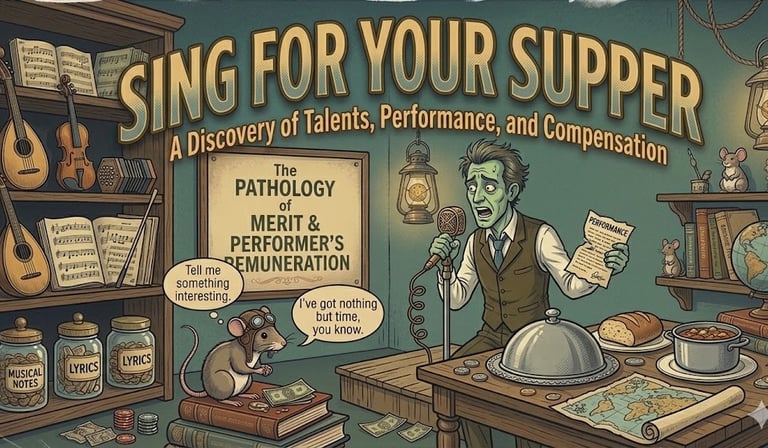
This idiom refers to the requirement that an individual perform a service or provide a specific value in exchange for a benefit, such as a meal, payment, or hospitality. It emphasizes that resources are not provided freely and that one must demonstrate their worth or "earn their keep" through active effort or talent.
The Deep Dive
The expression is rooted in the history of itinerant performers and the domestic economies of the 17th and 18th centuries, where professional entertainment was often bartered for basic necessities.
Itinerant Minstrels: In the era before recorded media, traveling musicians, poets, and storytellers moved from town to town. These performers would often visit local taverns or private homes, offering their artistic skills in exchange for a meal and a place to sleep. If the "flock" of patrons was not entertained, the performer might find themselves without a bed, making the act of "singing" a literal requirement for survival.
Domestic Social Barter: Beyond the world of professional musicians, the phrase also described the expectations placed on guests in upper-class households. A guest who was invited to a dinner party was expected to contribute "junk knowledge," witty conversation, or musical talent to ensure the evening’s success. Those who failed to contribute were rarely invited back, having failed to "sing" for the hospitality they received.
Linguistic Longevity: The phrase was immortalized in the nursery rhyme Little Tommy Tucker, which dates back to at least 1744. The lyrics state, "Little Tommy Tucker sings for his supper / What shall he eat? White bread and butter." This simple verse cemented the idea that even children were expected to provide some form of "performance" or obedience to receive their rewards.
Fast Facts
The "Working for Peanuts" Connection: While "sing for your supper" implies an exchange of talent for a necessity, "working for peanuts" implies that the compensation provided is insultingly small, regardless of the effort expended.
The Corporate Pivot: In modern business, a consultant or freelancer is often asked to "sing for their supper" during a pitch or a trial period. It represents an of proof, requiring the individual to deliver immediate results before a long-term contract is signed.
References
Opie, I. & Opie, P. (1951). The Oxford Dictionary of Nursery Rhymes.
Ammer, C. (2013). The Dictionary of Clichés. Skyhorse Publishing.
Oxford English Dictionary. (2026). The Economic History of Itinerant Performance.