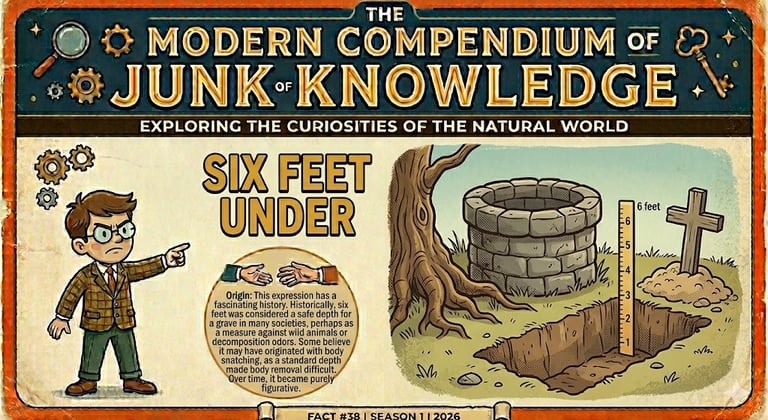
Six Feet Under
The Definition
A common euphemism for death and burial, referring to the standard depth at which a coffin is placed in a grave. To be "six feet under" is to be officially out of the land of the living, safely tucked away in the "basement" of the earth.
The Deep Dive
The "junk knowledge" behind "six feet under" is that the number six wasn't chosen for comfort or tradition, but as a desperate public health measure. The standard originates from the Great Plague of London in 1665.
The Plague Decree: During the height of the Black Death’s resurgence in London, the Mayor issued a series of orders to control the spread of infection. One specific decree stated that all graves must be at least six feet deep to prevent "the miasma" (then believed to be bad air) from rising and to stop animals from digging up the infected remains.
The "Miasma" Myth: At the time, doctors didn't understand germ theory. They believed the plague was spread by foul smells. They figured six feet of packed dirt was the "magic number" required to seal in the scent of death and prevent the wind from "scattering" the plague to the neighbors.
The Practical Reality: While the six-foot rule became a cultural standard, it was rarely followed perfectly. In many crowded London churchyards, gravediggers struggled to reach that depth without hitting the water table or disturbing previous "tenants." Today, most modern graves are actually only about four feet deep to the top of the coffin, as modern vaults and liners provide the protection that extra dirt once did.
The phrase reached peak "junk" status in the mid-20th century, becoming the title of everything from blues songs to HBO dramas. It represents the "junk" of medical history: a specific number born out of a misunderstanding of how diseases spread, which we still use as a shorthand for the end of the road.
Fast Facts
The "Safe" Grave: In the 18th and 19th centuries, the fear of being buried alive led to the invention of "safety coffins." These featured a bell above ground connected to a string inside the coffin. If a person woke up "six feet under," they could ring for help—leading to the (debated) origin of the phrase "saved by the bell."
The Water Table: In places like New Orleans, being "six feet under" is physically impossible due to the high water table. This is why the city is famous for its "Cities of the Dead"—above-ground tombs and mausoleums.
The Grave Robber Defense: A deeper grave also served as a deterrent for "resurrectionists" (body snatchers) in the early 19th century. Digging through six feet of heavy soil took significantly longer, increasing the chances of the thieves being caught.
References
Defoe, Daniel. A Journal of the Plague Year (1722).
Bondeson, Jan. Buried Alive: The Terrifying History of Our Most Primal Fear (2001).
Wilton, David. Word Myths: Debunking Linguistic Urban Legends (2004).
The Oxford English Dictionary (OED).Roach, Mary. Stiff: The Curious Lives of Human Cadavers (2003).