Skin of Your Teeth
The Definition
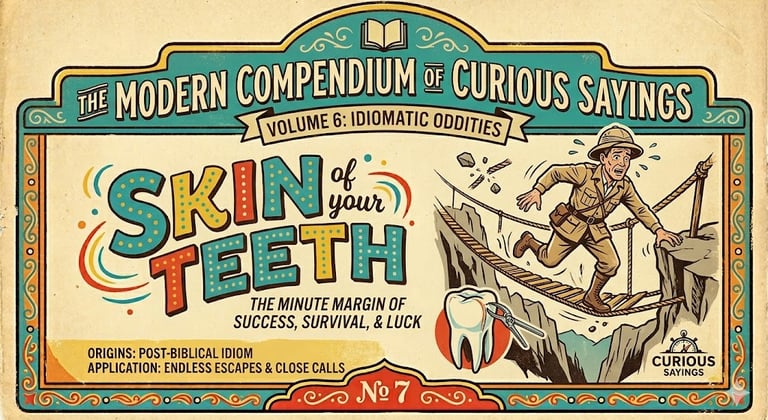
To narrowly escape a disaster, succeed by the smallest possible margin, or complete a task just before a deadline. It describes a situation where the difference between victory and catastrophe is microscopic—as thin as the non-existent "skin" on a tooth.
The Deep Dive
The "junk knowledge" behind "skin of your teeth" is that it is one of the oldest idioms in the English language, and it was originally a description of physical emaciation, not a close call in a car chase.
The Biblical Origin: The phrase first appears in the Book of Job (19:20). Job, having lost his wealth, his children, and his health, describes his miserable state: "My bone cleaveth to my skin and to my flesh, and I am escaped with the skin of my teeth."
The Literal Paradox: Teeth, of course, do not have skin. They have enamel. In the original Hebrew, the phrase is more accurately "the gum of my teeth." However, when William Tyndale translated the Bible into English in the 16th century, he opted for "skin," likely to emphasize how little of Job's body was left. He had "escaped" death, but with nothing remaining except a part of his body that doesn't even exist.
The 19th-Century Shift: For centuries, the phrase was used to describe someone who was "barely alive." It wasn't until the mid-1800's that it shifted into its modern meaning of a "narrow miss." This was popularized in part by Thornton Wilder’s 1942 play The Skin of Our Teeth, which used the phrase to describe humanity’s habitual narrow escapes from self-destruction.
The phrase reached peak "junk" status in the 20th century, becoming the favorite cliché of sports announcers and action movie trailers. It represents the "junk" of linguistic evolution: a translation error that became a permanent fixture of our collective vocabulary.
Fast Facts
The Enamel Connection: If we want to be scientifically accurate, the "skin" of your teeth is the Acquired Pellicle—a thin film of salivary proteins that forms on the surface of the enamel within minutes of brushing. It is roughly 1 to 2 microns thick, which is a "narrow margin" indeed.
The "Gums" Variation: In some older English dialects, people used the phrase "by the hair of my head" to mean the same thing, though "skin of your teeth" won the popularity contest due to its sheer anatomical absurdity.
The "Saved by a Whiskers" Rival: While similar, "by a whisker" has a more literal origin in horse racing, where a win could be determined by the length of a single hair on a horse's nose.
References
The Bible. (KJV). Job 19:20.
Tyndale, W. (1530). The Five Books of Moses.
Wilder, T. (1942). The Skin of Our Teeth. Harper & Brothers.