Sleep Tight
The Definition
A common affectionate farewell before bed, wishing the listener a sound and restful night’s sleep. It implies a sense of security, comfort, and physical stillness.
The Deep Dive
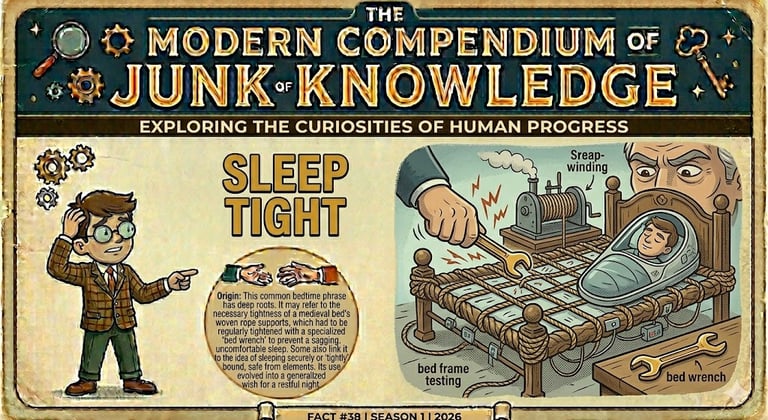
This phrase is the heavyweight champion of "junk knowledge" found in historic house museums. If you take a tour of an 18th-century home, the guide will almost certainly point to a rope-slung bed and explain that before the invention of metal springs, mattresses were supported by a network of crisscrossed ropes.
The Rope Theory: Over time, these ropes would sag under the sleeper's weight. To ensure a comfortable night, one had to use a "bed wrench" to pull the ropes taut. Hence, to "sleep tight" meant to sleep on a properly tightened bed.
The Linguistic Reality: While the beds were real, the etymology is likely a "backronym" (a story made up to fit a phrase). The word "tight" in the 18th and 19th centuries was a common synonym for "soundly," "securely," or "properly."
Think of the phrase "sit tight" or "the ship is watertight." To sleep tight simply meant to sleep "well and truly." Furthermore, the phrase doesn't appear in print until the late 1800's—long after rope beds had been replaced by metal springs in most households. It was first popularized in children’s nursery rhymes and bedtime stories as a comforting rhythmic pairing with "good night."
Fast Facts
The "Bed Bug" Link: The full rhyme—"Good night, sleep tight, don't let the bed bugs bite"—emerged in the mid-20th century, likely as a playful way to acknowledge the reality of domestic pests before modern pest control.
The First Print: One of the earliest recorded uses is from an 1866 diary entry: "Goodbye, little One. Sleep tight."
The Navy Myth: A secondary piece of junk knowledge suggests it refers to sailors "tying" themselves into their hammocks so they wouldn't fall out during a storm, though "sleep soundly" remains the more likely linguistic ancestor.
References
Ammer, C. (2013). The Dictionary of Clichés. Skyhorse Publishing.
Quinion, M. (2004). Port Out, Starboard Home: The Rise and Fall of the Nautical Metaphor. Penguin.
Wright, T. (1892). The Romance of the Shoe. (Referencing the word "tight" as "secure").
The Oxford English Dictionary. (2026). Tight (adv.). Oxford University Press.