Smoke and Mirrors
The Definition
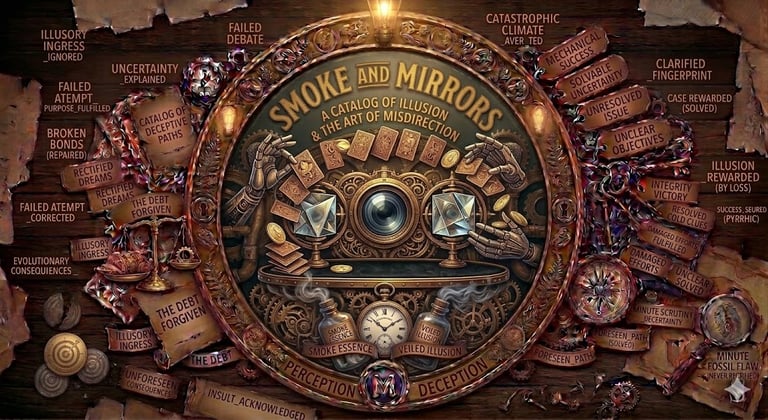
"Smoke and mirrors" refers to a deceptive or misleading explanation or description that obscures the truth. It describes a situation where someone—often a politician, marketer, or executive—uses clever phrasing or flashy visuals to distract from a lack of substance, a "hot mess" of data, or a failure to deliver on a promise.
The Deep Dive
The phrase is a literal description of the tools used by 18th- and 19th-century stage magicians and "phantasmagoria" showmen to create convincing illusions.
Phantasmagoria: In the late 1700's, entertainers used a "magic lantern" (an early type of image projector) to project ghosts and demons onto screens or even onto clouds of smoke. By carefully positioning mirrors, they could make these images appear to move, grow, or vanish into thin air. The "smoke" provided a semi-transparent medium that made the light look like a physical entity, while the "mirrors" allowed the projection equipment to remain hidden from the audience.
The Stage Reveal: As stage magic became more sophisticated, magicians used elaborate mirror arrays to make objects disappear or to create the "Pepper's Ghost" effect (making a person appear on stage while the actual performer was hidden below). To an unsuspecting audience, it was a miracle; in reality, it was a carefully engineered distortion of light.
Political Transition: The idiom moved from the theater to the newsroom in the mid-20th century. One of its first major uses in a political context occurred in 1975, when journalist Jimmy Breslin used it to describe the budget maneuvering of the New York City government. It perfectly captured the idea of using "junk" accounting and "mirage" projections to hide the fact that the city was essentially in the hole.
Fast Facts
Modern Usage: Today, the phrase is frequently applied to high-tech startups that promise revolutionary technology that doesn't yet exist, or to "creative" bookkeeping that makes a failing company look profitable.
The "Nothing Up My Sleeve" Connection: While "smoke and mirrors" implies a complex technical deception, "nothing up my sleeve" refers to the older, more personal sleight of hand used by street performers.
References
Breslin, J. (1975). How the Good Guys Finally Won.
Ammer, C. (2013). The Dictionary of Clichés. Skyhorse Publishing.
Oxford English Dictionary. (2026). The Mechanics of Victorian Stage Illusions in Modern Rhetoric.