Speed of a Sneeze
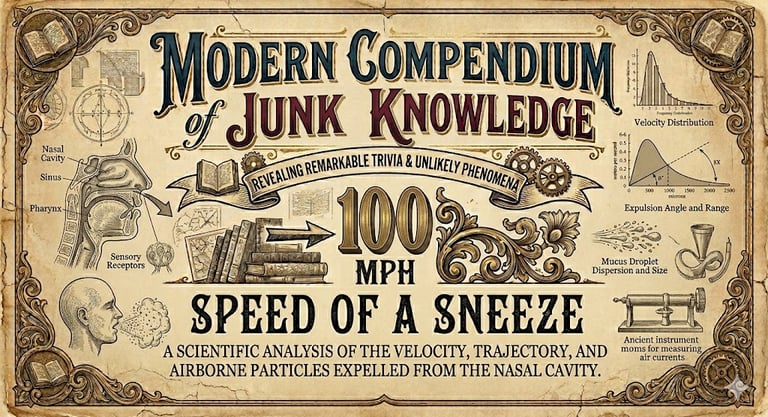
The Definition
A sneeze, or sternutation, is a semi-autonomous, convulsive expulsion of air from the lungs through the nose and mouth. It is the body’s "emergency reboot" for the nasal cavity, triggered by irritation in the mucous membranes. While long-cited as one of the fastest biological actions, modern science has recently "debunked" the most extreme speed claims.
The Deep Dive
The "junk knowledge" behind the speed of a sneeze is that for decades, we believed they traveled at the speed of a hurricane. If you grew up reading trivia books, you likely "learned" that a sneeze clocks in at 100 miles per hour (160 km/h).
The Great Deceleration: In 2013, researchers at the University of Alberta used high-speed cameras and synchronized LED strobes to actually measure the velocity of sneeze droplets. They found that the average sneeze travels at a much more modest 10 to 35 miles per hour (16 to 56 km/h). While still fast, it's more like a brisk bicycle ride than a Category 5 storm.
The "Mist" Factor: The reason the "100 mph" myth persisted is likely due to the exit velocity of the smallest particles at the very start of the sneeze. While the bulk of the air moves slower, microscopic droplets can be whipped into a frenzy by the sudden contraction of the chest muscles.
The Radius of Contamination: Even at 30 mph, a sneeze is a formidable dispersal unit. A single sneeze can release up to 40,000 droplets. Larger droplets fall to the ground within a few feet (the "six-foot rule"), but the finer "junk" particles can stay suspended in the air for minutes and travel across an entire room, effectively "scattering to the winds" of an office or classroom.
The speed of a sneeze reached peak "junk" status during the global health crises of the early 2020's. It represents the "junk" of biological mechanics: a reflex so powerful it can temporarily "take a load off" your heart rhythm (though it doesn't actually stop your heart, despite the urban legend).
Fast Facts
The Photic Sneeze Reflex: About 18% to 35% of the population sneezes when suddenly exposed to bright light (like walking out of a movie theater). This is known as ACHOO syndrome (Autosomal Dominant Compelling Helio-Ophthalmic Outburst). It’s essentially a "wiring glitch" where the signal from the optic nerve is "sticking its nose in" the trigeminal nerve, which controls sneezing.
The Eyes-Shut Rule: It is physically impossible to keep your eyes open during a sneeze. This isn't because your eyes will "pop out" (another bit of medical junk), but because the sneeze reflex is coordinated by the brainstem, which sends a simultaneous signal to the eyelids to close as a protective measure against the high-pressure spray.
The "Bless You" Origin: The tradition of saying "Bless you" dates back to the Plague of Rome in 590 AD. Pope Gregory I ordered the prayer because sneezing was often the first sign that someone had been "given the axe" by the plague.
References
Han, Z. Y., et al. (2013). Characterizing the Micro-environment of Human Sneezes. University of Alberta.
Scherer, P. W. (1985). The Physics of Sneezing and Coughing.
MIT News. (2014). The Sneeze Cloud: Why You Should Cover Your Mouth.