Spinning Your Wheels
The Definition
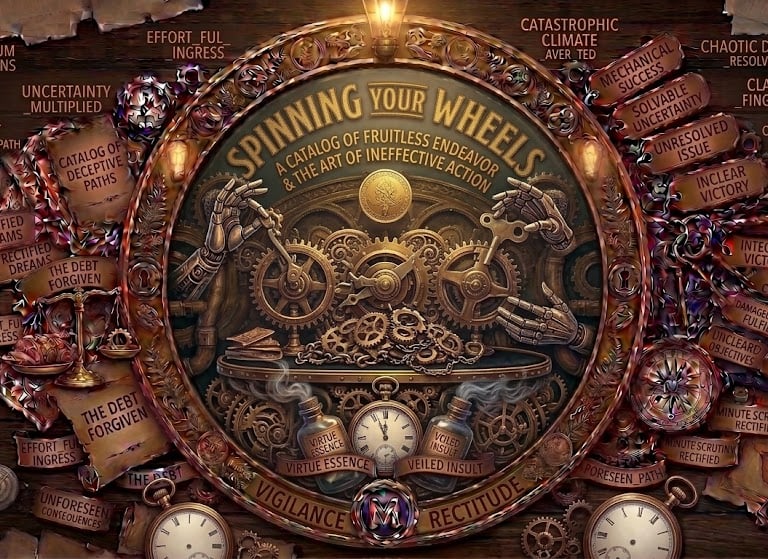
To "spin your wheels" is to expend a great deal of effort or energy without making any actual progress. It describes a state of stagnant activity where, despite the intent to move forward, one remains stuck in the same position, often becoming increasingly frustrated or exhausted.
The Deep Dive
This idiom is a mechanical metaphor that rose to prominence alongside the development of the automobile in the early 20th century.
The Loss of Traction: The phrase refers to the physical phenomenon of a vehicle’s tires rotating rapidly on a slippery surface—like mud, ice, or deep sand—without gripping the ground. Because there is no friction, the engine's power is wasted; the wheels spin faster and faster, but the car remains stationary. In many cases, this action actually makes the situation worse by digging the vehicle deeper into a hole.
The "Junk" Effort: In a professional or creative context, spinning your wheels often happens when a person focuses on minor details or "busy work" rather than the core problem. It’s the feeling of working a 60-hour week and realizing the project hasn't moved an inch. It suggests that the problem isn't a lack of power or desire, but a lack of "traction" with the reality of the task at hand.
The Solution Shift: Just as a driver might need to put gravel or a floor mat under a tire to regain grip, a person spinning their wheels often needs to change their environment or strategy. It is the antithesis of momentum; it is a "hot mess" of high-revving energy that produces nothing but heat and noise.
Fast Facts
The "Treadmill" Parallel: A similar but older concept is "being on a treadmill," though that usually implies a repetitive, forced labor rather than the accidental loss of progress implied by spinning wheels.
Psychological Burnout: Experts often use this phrase to describe the early stages of burnout, where the harder a person tries to catch up, the more "stuck" they feel in their current circumstances.
References
Ammer, C. (2013). The Dictionary of Clichés. Skyhorse Publishing.
Lighter, J. E. (1994). Historical Dictionary of American Slang.
Oxford English Dictionary. (2026). The Automotive Influence on 20th-Century Productivity Metaphors.