Splitting Hairs
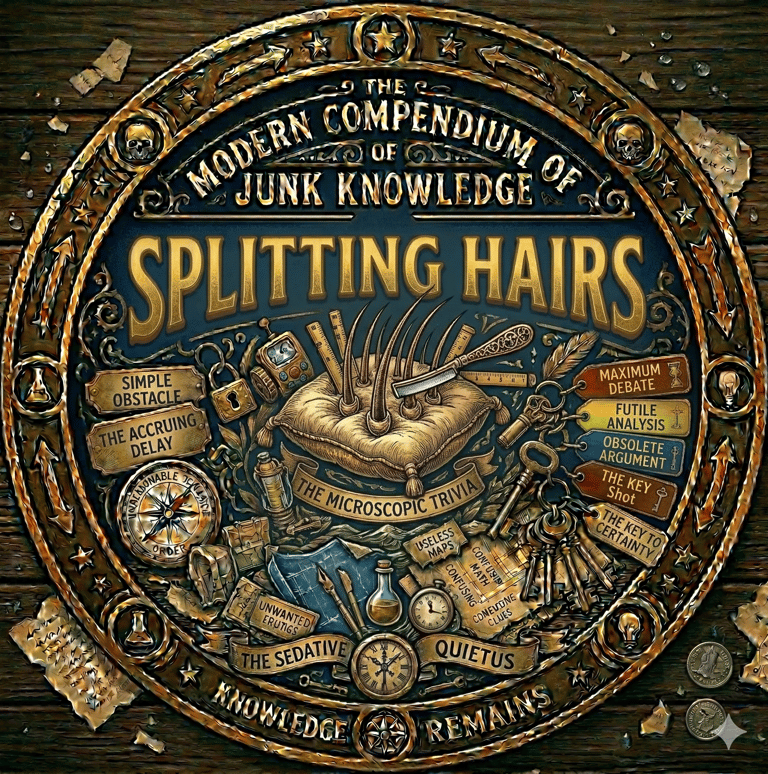
The Definition
To make over-refined, trivial, or unnecessary distinctions; to argue about minute details that have no practical relevance to the main issue. It is the verbal equivalent of a microscope, focusing on a speck while ignoring the mountain.
The Deep Dive
The "junk knowledge" behind this phrase is the physical impossibility of the premise. Until the development of high-precision steel blades and eventually lasers, the idea of literally "splitting" a single human hair down its length was considered a feat of almost supernatural skill or a philosophical absurdity.
The Philosophical Absurdity: In the 16th and 17th centuries, the phrase was used to mock scholars and theologians who spent hours debating microscopic points of dogma. To "split a hair" was to engage in a task that was not only incredibly difficult but also entirely pointless—as a hair split in two is still just a hair.
The Master Barber: While largely a metaphor, the "hair-splitting" test was a legendary benchmark for the sharpness of a blade. A razor was said to be "scary sharp" if it could catch a free-hanging hair and slice it lengthwise. In the world of 19th-century trade, a craftsman who claimed they could "split hairs" was often seen as a braggart who focused on "showy" skills rather than useful ones.
The phrase was a favorite of William Shakespeare, who used it to describe someone who could "find quarrel in a straw." By the time the Industrial Revolution arrived, the phrase had moved from the barber shop to the courtroom and the laboratory, becoming the definitive term for any argument that prioritizes technical correctness over common sense.
Fast Facts
The "By a Hair" Sibling: While "By a Hair’s Breadth" is about a narrow escape, "Splitting Hairs" is about the division of that tiny space, moving from the realm of measurement into the realm of pedantry.
The Scientific "Split": In modern trichology (the study of hair), "splitting hairs" is a medical condition known as trichoptilosis. Unlike the idiom, which implies a vertical split, real split ends usually occur at the tip when the protective cuticle is destroyed.
The Greatest Splitter: In 19th-century political cartoons, lawyers were often depicted with giant scissors, literally trying to split a single hair labeled "The Truth" to show how they could make one fact look like two different things.
References
Shakespeare, W. (1597). Henry IV, Part 1. ("I’ll cavil on the ninth part of a hair").
Ammer, C. (2013). The Dictionary of Clichés. Skyhorse Publishing.
Erasmus, D. (1511). The Praise of Folly. (Satirizing the "hair-splitting" logic of medieval scholastics).
The Oxford English Dictionary. (2026). Split (v.). Oxford University Press.