The Definition
A substantial, satisfying, and balanced repast. It implies a meal that is honest in its portion size and nutritional value, providing enough "fuel" to sustain a person through a full day of labor.
The Deep Dive
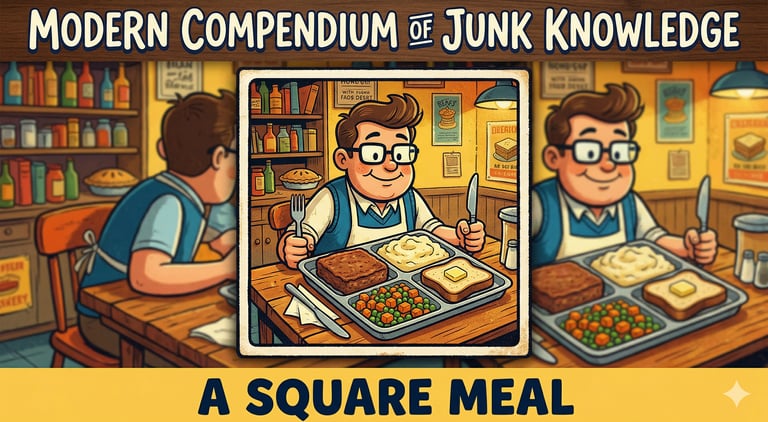
The "junk knowledge" behind "a square meal" is one of the most persistent myths in the English language. If you visit a maritime museum or take a historical tour, you will almost certainly be told that the phrase comes from the square wooden plates used by sailors on 18th-century warships. The story goes that because the plates were square, a meal that filled the corners was a "square meal."
While it makes for a great story, etymologists and naval historians have largely debunked this as a "back-formation"—a story made up later to explain a phrase whose origin was forgotten.
The Figurative "Square": The term actually derives from the 16th-century use of the word "square" to mean honest, fair, or proper. This is the same "square" found in phrases like "a square deal," "fair and square," and "squaring an account." A "square meal" was simply a "proper" or "honest" amount of food.
The American Frontier: Despite the British seafaring myths, the phrase is actually an Americanism. The earliest recorded uses appear in the mid-19th century during the California Gold Rush. Miners in the 1850's used "square meal" to distinguish a full, sit-down dinner of meat and vegetables from the meager, transient snacks often consumed in the camps.
Mark Twain’s Witness: In his 1869 book The Innocents Abroad, Mark Twain referred to it as a "Californian expression," noting that it was a local slang term for a substantial repast. By the 1880's, the phrase had traveled back across the Atlantic and become a staple of the global English vocabulary.
The phrase reached peak "junk" status in the mid-20th century as it became the standard way to describe the "three-square-meals-a-day" ideal of the nuclear family. It represents the "junk" of linguistic evolution: our tendency to invent colorful, physical origins (like wooden plates) for abstract concepts that are actually rooted in simple, boring definitions of "honesty."
Fast Facts
The "Trenchers": While square wooden plates (called trenchers) did exist in the Middle Ages, they had largely fallen out of use by the time the phrase "square meal" actually appeared in the 1850's.
The Military Myth: Another variation of the myth claims the phrase comes from the "square" posture required of some military cadets while eating—sitting perfectly upright with elbows at 90-degree angles. Like the plate story, there is no evidence to link this practice to the coining of the term.
The "Square" Deal: President Theodore Roosevelt famously used the "square" metaphor in his "Square Deal" domestic program, promising every citizen a fair and honest chance in the economy, further cementing the "square = honest" association in the American mind.
References
Twain, M. (1869). The Innocents Abroad.
Ammer, C. (2013). The Dictionary of Clichés. Skyhorse Publishing.
World Wide Words. (2026). The Myth of the Square Plate.
The Oxford English Dictionary. (2026). Square (adj.). Oxford University Press.