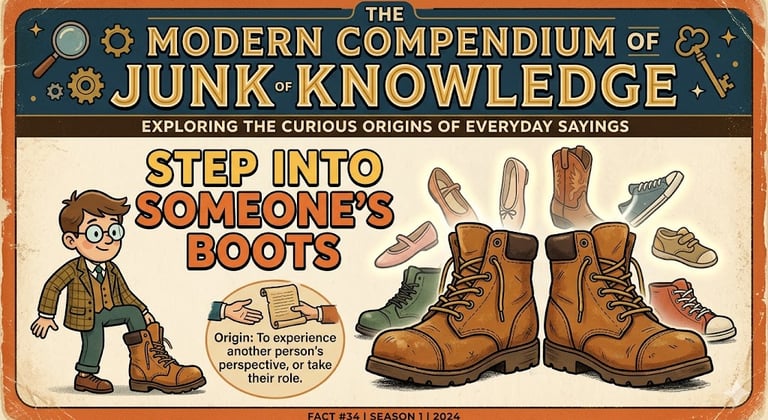
Step into Someone's Boots
The Definition
A common idiom meaning to take over someone else’s position, responsibilities, or role—often under pressure or following a sudden departure. It implies that the person being replaced was a significant figure, and the newcomer must now live up to their reputation, authority, or physical "footprint."
The Deep Dive
The "junk knowledge" behind "stepping into someone’s boots" is that it is the more rugged, blue-collar cousin of "stepping into someone's shoes." While "shoes" is about empathy (seeing the world from their perspective), "boots" is about utility and burden.
The Military Standard: The phrase gained its modern weight in the 19th-century military. When a high-ranking officer fell in battle, the subordinate who took their place was literally stepping into the command "boots" of their predecessor. In a world of mud, horses, and trenches, boots were the most essential piece of equipment—if you couldn't "fill them," you couldn't lead.
The "Dead Man's Shoes" Connection: In the Royal Navy and merchant fleets of the 18th century, "waiting for dead man’s shoes" was a grim but common expression for seeking a promotion. Because rank was strictly limited, the only way to move up was for someone above you to die. To "step into their boots" was to claim the physical and professional remains of the deceased.
The Wellington Factor: The "boot" became a symbol of national identity and authority in Britain following the Duke of Wellington’s victory at Waterloo. The Wellington Boot (originally leather, later rubber) became the standard for the ruling class. To step into an Earl’s or a General’s boots was to inherit their "stride"—their way of moving through the world with power.
The phrase reached peak "junk" status in the mid-20th century as a favorite of sports coaches and corporate executives. It represents the "junk" of succession: the anxiety that we aren't just taking a job, but trying to inhabit the very "soul" of the person who came before us.
Fast Facts
The Empathy Split: While "step into their shoes" comes from a Cherokee proverb ("Don't judge a man until you have walked a mile in his moccasins"), "step into their boots" is almost exclusively European and military in origin. One is about feeling, the other is about doing.
The "Big Shoes to Fill" Variant: This modern evolution likely comes from the world of vaudeville and clowning, where oversized shoes were a literal prop. It emphasizes that the predecessor’s "act" was so large that the successor looks small by comparison.
The Rubber Boot Revolution: When Charles Goodyear (who also gave us the vulcanization used in early erasers) applied his technology to boots, they became "Wellies." Stepping into someone's "Wellies" remains a common way in the UK to describe taking over a messy or difficult outdoor task.
References
Wellington, A. W. (1815). Dispatches from the Field.
Ammer, C. (2013). The Dictionary of Clichés. Skyhorse Publishing.
The National Army Museum. (2026). The Evolution of Military Footwear: 1750-1900.