Straight Arrow
The Definition
This idiom refers to a person who is exceptionally honest, moral, and upright. It describes an individual who adheres strictly to social and legal rules, demonstrating a level of integrity that is consistent and predictable. Such a person is often seen as the antithesis of a "blockhead" or a rebel, choosing a path of maximum reliability.
The Deep Dive
The phrase is a "kinematic" metaphor, drawing on the physical properties of a well-crafted projectile to describe human character.
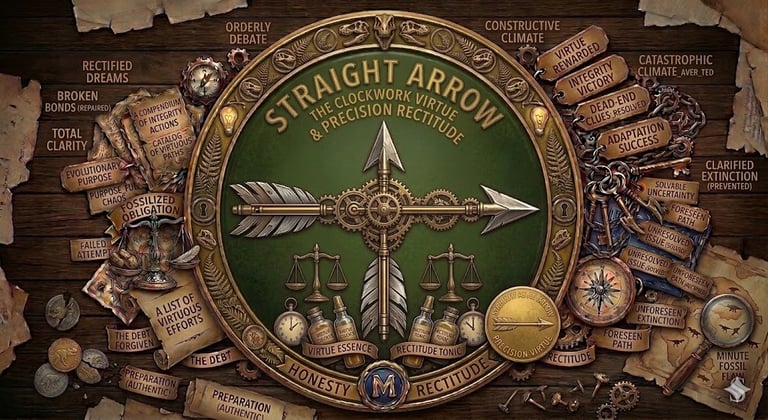
Ballistic Accuracy: The core of the metaphor lies in the flight of an arrow. For an arrow to reach its target accurately, its shaft must be perfectly straight. Any deviation or warp in the wood would cause the arrow to veer off its intended path. Historically, a "straight arrow" was a literal requirement for survival and success in hunting and warfare, which naturally translated into a symbol for a person whose life follows a direct and true trajectory.
Indigenous Influence: In the early 20th century, the phrase was often associated with stylized depictions of Native American cultures in Western literature and film. Characterized by a "straight-shooting" honesty, the term was used to describe those who spoke without deception. While these depictions were often simplistic, they cemented the "straight arrow" in the American lexicon as a shorthand for moral fortitude.
The "Square" Connection: The idiom shares a thematic bond with the concept of being "fair and square." Both rely on geometric perfection—the straight line and the right angle—to represent the absence of crookedness or corruption in a person’s dealings.
Fast Facts
The "Boy Scout" Rival: In modern vernacular, a "straight arrow" is often compared to a "Boy Scout." While both imply high moral standards, the latter sometimes carries a slightly patronizing tone, whereas "straight arrow" typically remains a mark of respect for one's steadfastness.
Archery Integrity: In the Middle Ages, the guild of fletchers (arrow-makers) was strictly regulated to ensure that every arrow produced was "true." A fletcher who sold warped shafts was seen as a fraud, reinforcing the link between the straightness of the tool and the honesty of the maker.
References
Ammer, C. (2013). The Dictionary of Clichés. Skyhorse Publishing.
Ayto, J. (1990). Dictionary of Word Origins. Arcade Publishing.
Oxford English Dictionary. (2026). The Ballistic Metaphors of Moral Character.