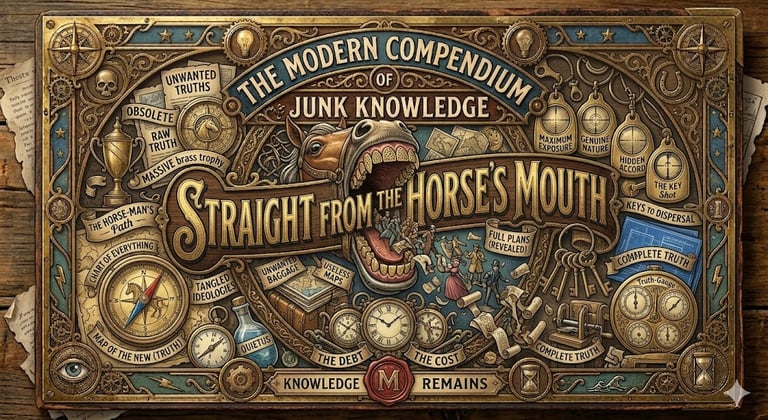
Straight from the Horse's Mouth
The Definition
Information received directly from the highest authority or the most reliable source. It implies that the news is not secondhand gossip or a "best guess," but an immutable fact verified by the source itself.
The Deep Dive
This is a "high-velocity" piece of junk knowledge from the high-stakes world of 19th-century horse trading. Before the invention of digital registries and microchips, buying a horse was a game of deception. Sellers would lie about a horse's health, its lineage, and—most importantly—its age.
The "Bishoping" Scam: Shrewd traders would sometimes perform "Bishoping"—using a hot iron to burn fake dark spots into a horse's teeth to make an old animal look younger and more valuable.
The Biological Truth: A horse’s teeth tell a story that a seller cannot easily rewrite. As a horse ages, its teeth change in predictable ways: they grow longer, change shape (from oval to triangular), and develop a specific groove (Galvayne's groove) at certain years.
The Final Inspection: To get the "true" age of the horse, a savvy buyer wouldn't listen to the trader's sales pitch. They would physically pry open the animal's jaws and look straight into the horse’s mouth. The teeth provided a biological "timestamp" that was impossible to forge.
The Racetrack Shift: By the 1920's, the phrase moved from the trading post to the racetrack. If a stable hand or a trainer told you which horse was "feeling it" that morning, you weren't betting on a whim—you had information straight from the source of the action.
The phrase reached peak popularity in the mid-20th century as a general idiom for any verified "inside scoop." It serves as a reminder that while people can lie, the physical evidence—the "mouth" of the situation—usually tells the truth.
Fast Facts
The "Look a Gift Horse in the Mouth" Cousin: This is a direct linguistic sibling. To do so is considered rude because you are essentially checking the "value" (the age) of something given to you for free.
The "Long in the Tooth" Link: This is another "dental" idiom. Because horses' teeth appear to grow longer as their gums recede with age, a "long in the tooth" horse (or person) is simply an old one.
The First Print: While the practice is ancient, the exact English idiom appeared in London sporting newspapers in the 1830s' to describe "sure-thing" betting tips.
References
Youatt, W. (1831). The Horse. (A classic veterinary text on equine age).
Ammer, C. (2013). The Dictionary of Clichés. Skyhorse Publishing.
Flexner, S. B. (1982). Listening to America. Simon & Schuster.
The Oxford English Dictionary. (2026). Horse (n.1). Oxford University Press.