Super Glue
The Definition
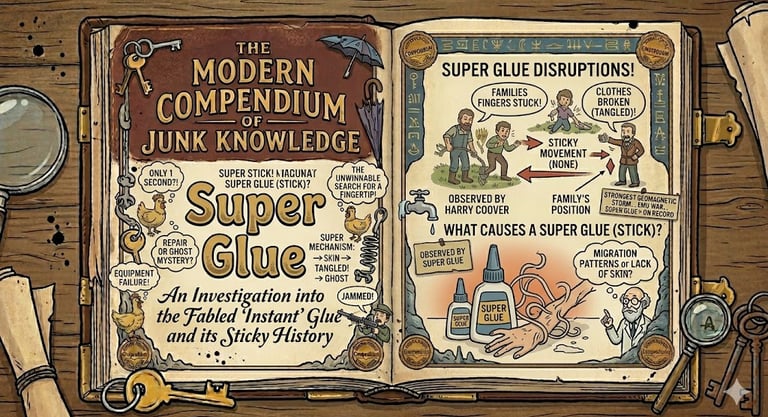
A fast-acting, high-strength adhesive technically known as cyanoacrylate. Unlike traditional glues that dry through evaporation, Super Glue undergoes a chemical reaction called "anionic polymerization" triggered by the presence of moisture (even the invisible humidity in the air). It is the definitive "oops" fixer, capable of bonding nearly any non-porous surface in seconds—including, notoriously, human skin.
The Deep Dive
The "junk knowledge" behind Super Glue is that it was discovered twice by the same man, and both times he hated it. In 1942, Dr. Harry Coover was working for Eastman Kodak, trying to develop a clear plastic for precision gun sights for Allied soldiers in WWII.
The First Failure: Coover’s team synthesized cyanoacrylates, but they were a disaster. The substance was so incredibly sticky that it bonded to every piece of lab equipment it touched. Coover found it "annoying" and scrapped the formula entirely.
The Second Failure: Nine years later, in 1951, Coover was overseeing a project to create heat-resistant jet canopy plastic. A researcher named Fred Joyner tried to measure the refractive index of a cyanoacrylate sample by putting it between two expensive glass prisms. The prisms bonded together instantly and permanently.
The "Eastman 910" Launch: This time, Coover realized the "annoying" stickiness was actually a revolutionary product. It was launched in 1958 as "Eastman 910." To demonstrate its power, Coover famously appeared on I've Got a Secret and used a single drop of the glue to lift host Garry Moore off the ground using a metal bar.
Super Glue reached peak "junk" status in the 1970's and 80's as a household staple. It represents the "junk" of chemical impatience: the first adhesive that matched the speed of modern life. It turned the painstaking process of "repair" into a three-second "snap."
Fast Facts
The Vietnam Medical Myth: A common piece of "junk" lore is that Super Glue was invented to close wounds on the battlefield. This is a half-truth: it was not invented for that purpose, but field medics in Vietnam did use a spray-on version to stop hemorrhaging in soldiers with abdominal wounds, saving countless lives until they could reach a surgeon.
The Fingerprint Hero: Forensic scientists use "Super Glue fuming" to reveal fingerprints on non-porous surfaces. When heated, the glue’s vapors cling to the oils and moisture in a fingerprint, hardening into a white, visible plastic deposit.
The Cotton Fire: You should never use Super Glue on cotton or wool. Cyanoacrylate reacts exothermically with natural fibers, meaning it releases heat. A large enough spill on a cotton t-shirt can actually cause the fabric to smoke or catch fire.
References
Coover, H. W. (1956). U.S. Patent No. 2,768,109: Alcohol-Catalyzed Cyanoacrylate Adhesive Compositions.
Eastman Kodak Company. (1958). The 910 Technical Manual.
The New York Times. (2011). Harry Coover, 94, Dies; Invented Super Glue.