Tall Order
The Definition
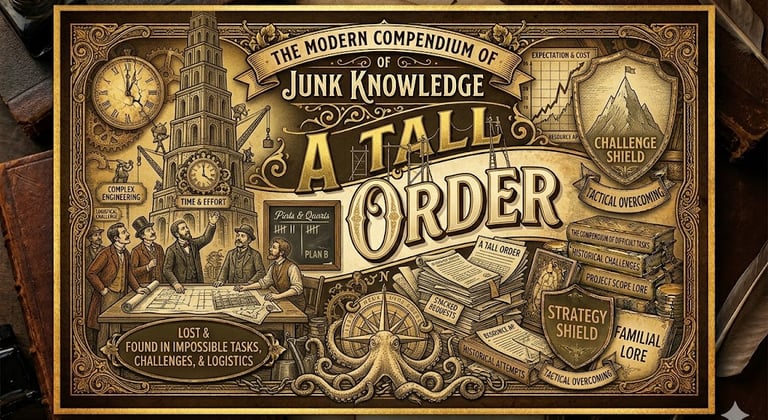
A colloquial idiom used to describe a task, request, or goal that is extremely difficult to fulfill, unreasonable in its demands, or nearly impossible to achieve within the given constraints. It is the linguistic opposite of "as easy as pie"—a "load" so heavy it looms over the person tasked with carrying it.
The Deep Dive
The "junk knowledge" behind "a tall order" is that it likely originated in the service industry of the 19th century, specifically in restaurants and bars. Before it became a metaphor for a difficult business project, it was a literal description of a very long, complex list of demands from a customer.
The Ledger of Demands: In the 1800's, orders were handwritten on long slips of paper or "tallies." A "tall" order was one that physically took up a lot of space on the paper because the customer wanted a vast amount of food, specific modifications, or rare items. To the waiter or the cook, a "tall" order meant a stressful shift and a high probability of failure.
The "Size" Metaphor: In English "junk" history, the word "tall" has often been used as a synonym for "large," "excessive," or "boastful." This is also where we get the phrase "tall tales" (exaggerated stories). A "tall order" is a task that has been "exaggerated" beyond the normal capabilities of a person to complete.
The "Vertical" Challenge: Think of it like a stack of "junk" boxes. A "short order" (like a short-order cook might handle) is quick and manageable. A "tall order" is a stack so high it’s unstable and requires a "ladder" of extra resources, time, or luck to reach the top.
The phrase reached peak "junk" status in the mid-20th century as it moved into the corporate world. It represents the "junk" of ambition: the moment when a manager "steps into their boots" and asks for a 50% increase in productivity by Tuesday, regardless of whether it's humanly possible.
Fast Facts
The "Short Order" Antonym: While a "tall order" is a burden, a "short order" is something that can be done immediately. This gave birth to the "short-order cook," the unsung hero of the "junk" food world who specializes in speed over complexity.
The "Big Ask" Rival: In modern Silicon Valley jargon, a "tall order" is often replaced by "the big ask." Both imply that the person making the request knows they are asking for a lot, but they’re doing it anyway.
The "Stiff" Alternative: In the early 1800's, people sometimes used the phrase "a stiff'un" to describe a hard task, but "tall order" eventually won the "flock" of popular usage because of its relatable connection to the hospitality industry.
References
Ammer, C. (2013). The Dictionary of Clichés. Skyhorse Publishing.
Ayto, J. (1990). Dictionary of Word Origins. Arcade Publishing.
Oxford English Dictionary. (2026). The Evolution of Commercial Similes.