That's the Way the Cookie Crumbles
The Definition
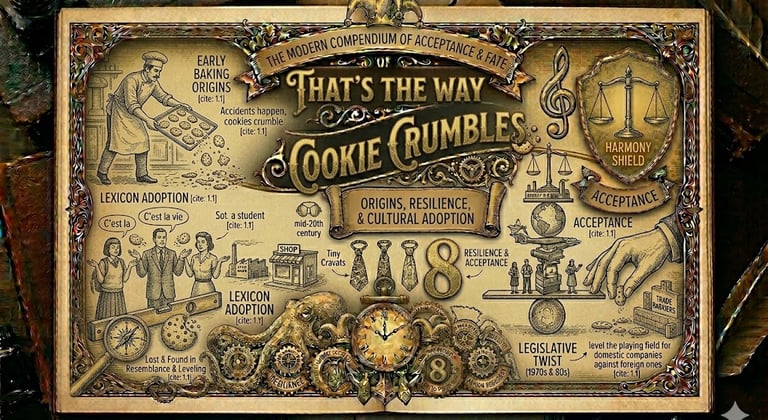
This idiom is used to express philosophical resignation toward a situation that has turned out unfavorably. It suggests that certain outcomes are beyond human control and one must simply accept the result with equanimity.
The Deep Dive
Despite its informal tone, the phrase is a relatively modern addition to the English language, emerging from the mid-20th century American advertising and media landscape.
Post-War Stoicism: The expression gained widespread popularity in the United States during the 1950's. It reflects a shift toward a more casual, suburban form of stoicism. Unlike older, more grave warnings about fate, this idiom uses a domestic, mundane object—a cookie—to illustrate that life is often fragile and unpredictable.
The "Junk" of Fragility: The metaphor relies on the physical properties of a crisp cookie. Once it begins to break, the way the pieces fall is random and irreversible. You cannot "get back to the drawing board" to reassemble the crumbs into their original form. It represents a tall order of acceptance: acknowledging that once a process has reached its conclusion, the specific details of the failure are often secondary to the fact of the failure itself.
Media and Pop Culture: The phrase was cemented through its frequent use in 1950's television and journalism. It was often employed by news anchors and writers to conclude a story about a stroke of bad luck or a failed venture, serving as a verbal shrug that signaled the end of the discussion.
Fast Facts
The "C'est la Vie" Equivalent: The phrase serves as the American English counterpart to the French c'est la vie (that's life) or the Italian così è la vita.
The "Ball Bounces" Rival: A common 1950's alternative was "that's the way the ball bounces." While both convey the same resignation, the "cookie" variant emphasizes the permanent, fragmented nature of the outcome, whereas the "ball" suggests a more kinetic, ongoing sense of chance.
References
Ammer, C. (2013). The Dictionary of Clichés. Skyhorse Publishing.
Lighter, J. E. (1994). Historical Dictionary of American Slang.
Oxford English Dictionary. (2026). The Rise of Domestic Metaphors in Mid-Century Media.