Thick as Thieves
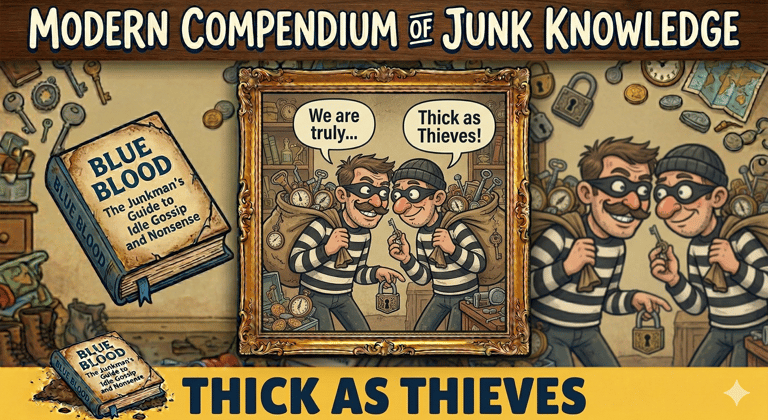
The Definition
To be extremely close, intimate, or conspiratorial with another person. It implies a relationship built on shared secrets, mutual protection, and a level of trust that excludes the rest of the world.
The Deep Dive
While we now use this to describe best friends or inseparable siblings, the "junk knowledge" origin is rooted in the gritty reality of the 18th-century criminal underworld. The word "thick" in this context doesn't refer to physical width or low intelligence; it is an archaic synonym for "crowded" or "closely packed."
In the early Georgian and Victorian eras, professional criminals (thieves, pickpockets, and "highwaymen") lived in a state of constant, shared peril. Their survival depended on a code of silence and an intense, insular social structure.
The "Flash" Language: Thieves often spoke in "Cant" or "Flash"—a secret slang designed to be unintelligible to the police (the "traps") and the public. This linguistic barrier physically and socially "thickened" their connection to one another.
The Necessity of Proximity: Because they were outlaws, thieves lived in "rookeries" (slum networks) where they were literally packed together for safety. To be "thick" was to be so closely intertwined—legally, socially, and physically—that you couldn't tell where one person's interests ended and the other's began.
The phrase moved from the "Newgate Calendar" (records of notorious crimes) into popular literature in the early 1800's. It was famously used by Theodore Hook in his 1833 novel The Parson's Daughter, cementing the idea that thieves were the gold standard for "us against the world" loyalty.
Fast Facts
The "Honor" Myth: The phrase is a sibling to "Honor among thieves." It suggests that while they may steal from the world, they never steal from—or betray—each other.
The Evolution of "Thick": In modern British English, "thick" can mean "stupid," but in this idiom, it retains its 1600's meaning of "intimate" (similar to how we say two people are "close").
The French Equivalent: A similar sentiment exists in the French phrase s'entendre comme larrons en foire ("to get along like thieves at a fair").
References
Hook, T. E. (1833). The Parson's Daughter. Bentley.
Grose, F. (1785). A Classical Dictionary of the Vulgar Tongue. S. Hooper.
Hotten, J. C. (1859). The Slang Dictionary. John Camden Hotten.
Ammer, C. (2013). The Dictionary of Clichés. Skyhorse Publishing.