Think Outside the Box
The Definition
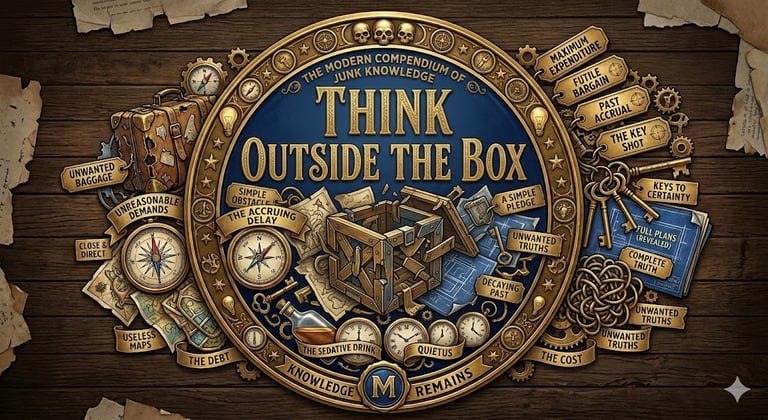
To approach a problem in an unconventional, creative way. It is a call to abandon traditional metaphors, standard procedures, and self-imposed limitations to find a solution that isn't immediately obvious.
The Deep Dive
While most modern users associate this phrase with a generic corporate "motivational" poster, the origin is a specific, frustrating psychological test known as the "Nine Dots Puzzle." Popularized in the 1970's and 1980's by management consultants, the puzzle presents a three by three grid of nine dots. The challenge is to connect all nine dots using only four straight lines, without lifting your pen from the paper.
The Mental Trap: Almost everyone who attempts the puzzle for the first time tries to stay within the "imaginary square" formed by the outer edges of the dots. When you stay inside that boundary, the puzzle is mathematically impossible to solve in four lines.
The Breakthrough: The only way to solve it is to draw lines that extend outside the perimeter of the grid. By literalizing the "box" as a self-imposed boundary, the solver can utilize the white space on the rest of the page to complete the task.
The phrase gained massive popularity in the 1970's, specifically within the "Lateral Thinking" movement led by Edward de Bono. By the 1990's, it had become the ultimate business cliché—ironically becoming such a "standard" way of talking about creativity that the phrase itself now represents the very "inside the box" thinking it was meant to discourage.
Fast Facts
Ancient Origins: While the phrase is 20th-century, the puzzle itself appears in Samuel Loyd’s Cyclopedia of Puzzles in 1914, where it was called the "Christopher Columbus Egg Puzzle."
The "Box" Paradox: Research by psychologists has shown that simply telling people to "think outside the box" rarely helps them solve the Nine Dots Puzzle. The mental boundary is so strong that most people need a direct hint that they are allowed to go outside the lines.
The 21st-Century Pivot: In recent years, designers have shifted to the phrase "Think Inside the Box," arguing that true creativity comes from working within constraints rather than ignoring them.
References
Loyd, S. (1914). Cyclopedia of Puzzles. The Lamb Publishing Co.
De Bono, E. (1970). Lateral Thinking: Creativity Step by Step. Harper & Row.
Kettler, T. (2014). The Power of Creative Constraints. Psychology Today.
Ammer, C. (2013). The Dictionary of Clichés. Skyhorse Publishing.