Three Body Problem
The Definition
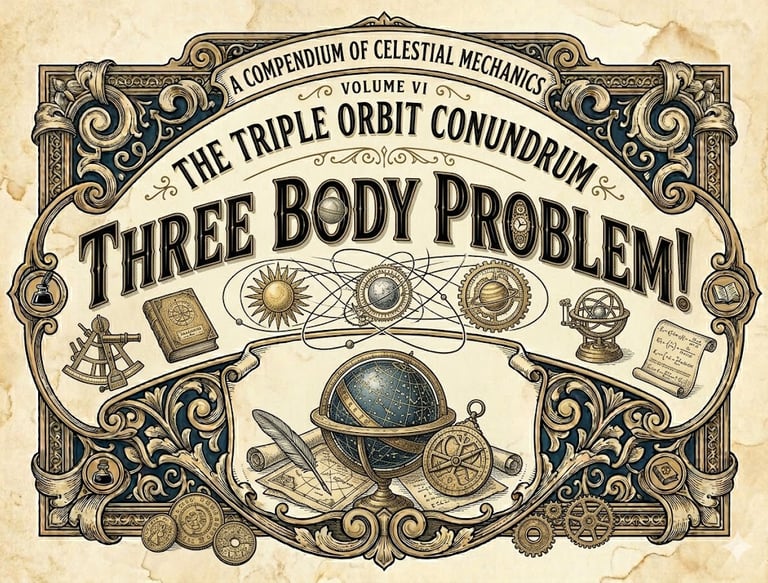
The Three-Body Problem refers to the challenge of calculating the motion of three celestial bodies (such as stars or planets) that interact with each other through gravity. Unlike a system with only two bodies, which follows a predictable path, a three-body system is famously unstable and chaotic. In modern metaphorical use, the term describes any situation involving three competing forces where the outcome is unpredictable, complex, and prone to sudden, drastic shifts.
The Deep Dive
The term has moved from the quiet observations of 17th-century physics to become a defining metaphor for chaos in the 21st century.
The Newtonian Wall: In the 1680’s, Sir Isaac Newton successfully used his law of universal gravitation to predict the "two-body" motion of the Earth and the Moon. However, when he attempted to factor in the Sun's gravitational pull on the Earth-Moon system, he hit a mathematical wall. Newton found it impossible to derive a simple formula that could predict the long-term positions of all three. He reportedly complained that the problem made his head ache.
Poincaré and the Birth of Chaos: For two centuries, mathematicians tried and failed to find a "straightforward" solution. In the late 1880’s, the French mathematician Henri Poincaré proved that a general solution was impossible because the system is inherently chaotic. He showed that even a microscopic change in the initial position of one star could lead to a wildly different—and unpredictable—future. This discovery laid the foundation for modern Chaos Theory.
The Marine Navigation Crisis: This wasn't just a theoretical headache; it was a practical disaster for 18th-century sailors. Accurate "lunar tables"—which required understanding how the Sun perturbed the Moon's orbit—were essential for determining longitude at sea. The inability to solve the three-body problem led to the Longitude Act of 1714, which offered a massive fortune to anyone who could solve the navigation crisis.
Cultural Rebirth: The term reached a massive global audience through Liu Cixin’s science fiction trilogy, The Three-Body Problem. The story uses the literal physics problem—a planet caught between three suns—to explore the fragility of civilization. This has turned the phrase into a popular idiom for geopolitical or social "tangles" where three powers (such as three nations or three rival corporations) are locked in a struggle that no one can fully control or predict.
Fast Facts
The "Figure-8" Solution: While a general solution is impossible, mathematicians have found a few "special cases" where three bodies can orbit stably. The most famous is the "Figure-8," where three equal masses chase each other in a perfect infinity loop.
The Search for Neptune: Discrepancies in the orbit of Uranus (a three-body interaction involving the Sun and an unknown planet) allowed astronomers to mathematically predict the location of Neptune before they ever saw it through a telescope.
References
Newton, I. (1687). Philosophiæ Naturalis Principia Mathematica.
Gleick, J. (1987). Chaos: Making a New Science. Viking Press.
Oxford English Dictionary. (2026). The Evolution of Classical Dynamics and Chaotic Systems.