Three Sheets to the Wind
The Definition
To be thoroughly drunk or unsteady on one’s feet. It describes a state of intoxication where a person is staggering or "reeling" like a ship in a storm.
The Deep Dive
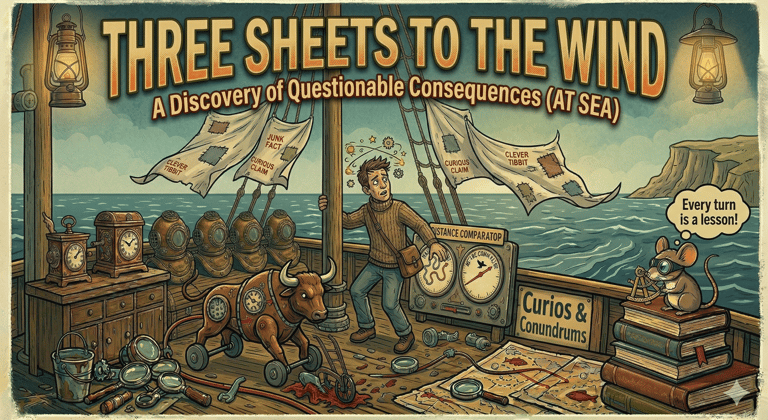
The most common "junk knowledge" mistake with this phrase is assuming that the "sheets" refer to bedsheets or the sails of a ship. In nautical terminology, a sheet is not the sail itself; it is the rope or chain used to control the tension and angle of a sail.
If a sheet is let go or "thrown to the wind," the sail is no longer under control. It flaps wildly (or "shivers"), and the ship loses its stability and direction. The phrase works on a graduated scale of drunkenness:
One sheet to the wind: Tipsy or slightly unsteady.
Two sheets to the wind: Noticeably drunk and weaving.
Three sheets to the wind: The point of total loss of control. On a three-masted ship, if the sheets for all three main sails were loose and "to the wind," the vessel would wallow helplessly, staggering in the waves with no ability to steer.
The phrase transitioned from sailor slang to common parlance in the early 19th century. One of the earliest literary appearances was in Pierce Egan’s Real Life in London (1821), where he described a character as being "three sheets in the wind."
The Drunken Sailor: By the time Robert Louis Stevenson used the phrase in Treasure Island (1883), it was the definitive way to describe a sailor who had spent too much time at the rum barrel.
Fast Facts
The Scale: Sailors actually used a four-point scale. "Four sheets to the wind" meant you were likely unconscious or "under the table."
The Physics: A ship with three sheets to the wind doesn't just go slow; it tips dangerously (heels) because the sails are catching the wind at random, chaotic angles.
The Terminology: Remember: Sails are the canvas; Sheets are the lines. If you pull the sheets, you aren't making the bed—you're trimming the boat.
References
Egan, P. (1821). Real Life in London; or, The Rambles and Adventures of Bob Tallyho, Esq. Jones & Co.
Jeans, P. D. (2004). Ship to Shore: A Dictionary of Pictorial Maritime Grammar. McGraw-Hill.
Smyth, W. H. (1867). The Sailor's Word-Book: An Alphabetical Digest of Nautical Terms. Blackie and Son.
Stevenson, R. L. (1883). Treasure Island. Cassell & Co.