Throw Someone Under the Bus
The Definition
To sacrifice a friend, colleague, or ally for personal gain or to avoid blame. It describes a sudden, cold-hearted betrayal where one person is "pushed" into the path of a metaphorical disaster so that another can escape unscathed.
The Deep Dive
While this feels like a gritty piece of 1920's Chicago gangster slang, the phrase is a surprisingly recent addition to the English language. It didn't gain widespread popularity until the late 20th century, specifically within the high-stakes worlds of British politics and professional sports.
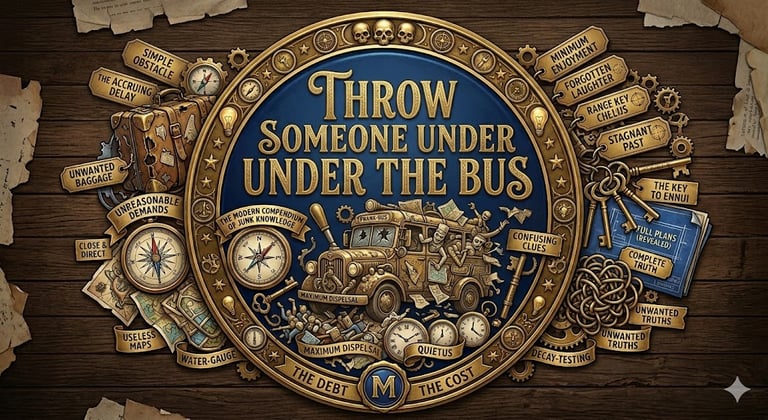
The imagery is visceral: a massive, unstoppable urban vehicle (the bus) represents a looming crisis, an angry boss, or a public scandal. To avoid being hit by the "bus" yourself, you shove someone else in front of it to act as a human speed bump.
The Political Pivot: The phrase began appearing in British newspapers in the 1970's and 80's. One of the earliest recorded uses was in The Times in 1982, describing a politician's willingness to sacrifice a subordinate to save their own career.
The "Double-Decker" Origin: Some etymologists argue the phrase evolved from an older British expression, "to fall under a bus," which was a standard way of describing a freak accident. The "throwing" part added a layer of malicious intent—transforming an accident into a calculated murder of a reputation.
The phrase crossed the Atlantic and exploded in American culture during the early 2000's, largely fueled by reality television (like Survivor and The Apprentice) and 24-hour cable news. It became the definitive term for the "blame game" in corporate boardrooms, where "bus-throwing" is often seen as a survival tactic for middle management.
Fast Facts
The "Under the Train" Variant: In many European languages, the equivalent phrase involves a train rather than a bus, reflecting the dominant mode of public transportation in those regions.
The Cyndi Lauper Connection: One of the earliest American pop-culture uses was by singer Cyndi Lauper in a 1984 interview, where she used the phrase to describe the fickle nature of the music industry.
The Professional Toll: In modern HR terminology, "throwing under the bus" is considered a primary symptom of a "toxic workplace culture," leading to a complete breakdown of team trust.
References
Safire, W. (2008). On Language: Under the Bus. The New York Times Magazine.
Ammer, C. (2013). The Dictionary of Clichés. Skyhorse Publishing.
The Times. (1982, June 21). Political Commentary. London.
Quinion, M. (2004). World Wide Words: Throw Under the Bus.