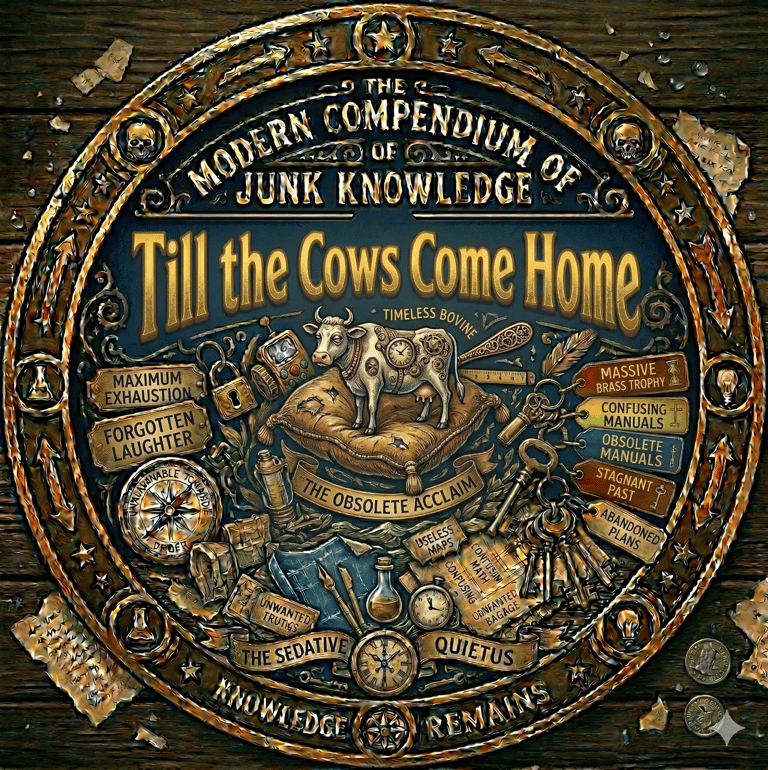
Till the Cows Come Home
The Definition
For a very long time; indefinitely. It describes an action that could continue for hours, days, or until a natural, inevitable cycle finally completes itself. It implies a sense of patience, almost rhythmic, waiting.
The Deep Dive
This is a "high-grazing" piece of junk knowledge that relies on the incredibly predictable—and incredibly slow—internal clock of a dairy cow.
The Morning Milestone: In a traditional farming community, cows are turned out to pasture in the early morning after their first milking.
The "Freedom" of the Field: Once in the pasture, cows have no reason to return. They wander, graze, and socialize. Because they lack a sense of "urgency," they will stay in the furthest reaches of the field for as long as there is grass to eat and sun to bask in.
The "Full" Return: Cows only "come home" to the barn when their udders become heavy and uncomfortable, or when the sun begins to set and they know the farmer is waiting with grain.
The "Indefinite" Wait: If you turn a cow out at 6:00 AM, she isn't coming back at 10:00 AM or noon. She is coming back in her own time, usually 12 to 14 hours later. To do something "till the cows come home" is to commit to a task that has no "fast-forward" button—it will take as long as it takes.
The phrase has been a staple of English rural life since the 16th century. It was famously used by the playwright John Fletcher in 1610, and later by Jonathan Swift in 1738. It captures a pre-industrial sense of time, where "deadlines" were set by biology and the setting sun rather than a ticking clock.
Fast Facts
The "Cow-Time" Variation: In some parts of Scotland and England, the phrase was originally "till the cows come home to the killing-place," a much darker version implying the cows would only return at the very end of their lives.
The "Cattle-Drive" Contrast: Unlike a stampede or a driven herd, cows "coming home" move at a glacial, rhythmic pace—roughly 2 miles per hour—adding to the sense of an "eternal" wait.
The First Print: One of the earliest recorded versions appeared in the play The Scornful Lady (1616): "I can stay... till the cows come home."
References
Swift, J. (1738). A Complete Collection of Genteel and Ingenious Conversation.
Fletcher, J. (1616). The Scornful Lady.
Ammer, C. (2013). The Dictionary of Clichés. Skyhorse Publishing.
The Oxford English Dictionary. (2026). Cow (n.1). Oxford University Press.