Too Many Irons in the Fire
The Definition
To be involved in too many activities or projects at the same time, leading to a loss of focus or a decrease in the quality of the work. It describes the point where ambition outstrips one's capacity to manage the details.
The Deep Dive
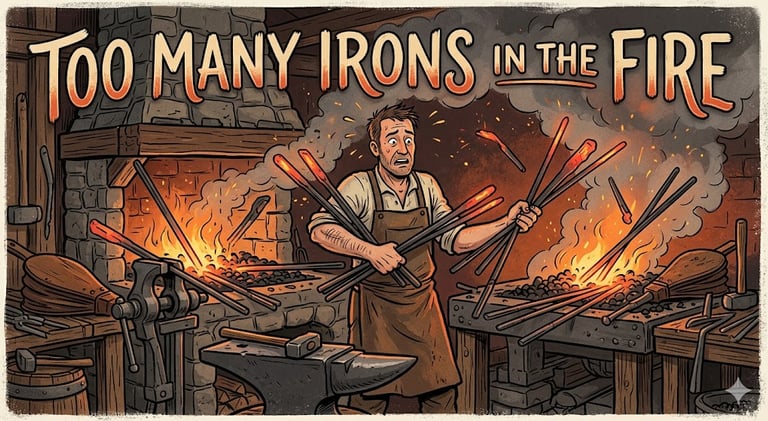
This phrase is a literal warning from the ancient and medieval blacksmith’s forge. Before the era of industrial automation, a blacksmith’s success depended entirely on their ability to manage temperature and timing.
When a blacksmith works with iron, they must heat the metal until it is "malleable"—a glowing orange or yellow. If the iron is too cold, it won't shape; if it stays in the fire too long, it will begin to "burn," becoming brittle or even melting into a useless spark-showering mess.
The Single-Tasker: Ideally, a smith works one piece at a time. They heat it, hammer it on the anvil, and return it to the coals.
The Overambitious Smith: To save time or handle a backlog of orders, a smith might put several "irons" (tools, horseshoes, or sword blades) into the forge at once.
The Disaster: Because the smith only has two hands and one anvil, they can only work one piece at a time. If they have "too many irons in the fire," they won't be able to get to the third or fourth piece before it overheats and is ruined.
The phrase moved from the soot-stained smithy to the general English vocabulary in the mid-16th century. It was popularized by writers like John Heywood in his 1546 collection of proverbs, serving as a timeless metaphor for the dangers of multitasking before the word "multitasking" even existed.
Fast Facts
The "Sweet Spot": Blacksmiths judge the temperature of the iron by its color. "Cherry red" is about 1,400°F, while the "welding heat" where iron begins to burn is over 2,400°F.
The Apprentice Factor: A master smith could handle more irons if they had a "striker" (an assistant) to help hammer, but "too many irons" was still a risk for even the most coordinated team.
Literary Roots: The phrase appears in various forms in 17th-century literature, including works by Thomas Fuller, who used it to describe men who overextended their political influence.
References
Heywood, J. (1546). A Dialogue Conteinyng the Nomber in Effect of All the Prouerbes in the Englishe Tongue.
Moxon, J. (1678). Mechanick Exercises: Or, the Doctrine of Handy-Works.
Ammer, C. (2013). The Dictionary of Clichés. Skyhorse Publishing.
Bealer, A. W. (1969). The Art of Blacksmithing. Funk & Wagnalls.