Triple-Hearted Octopus
The Definition
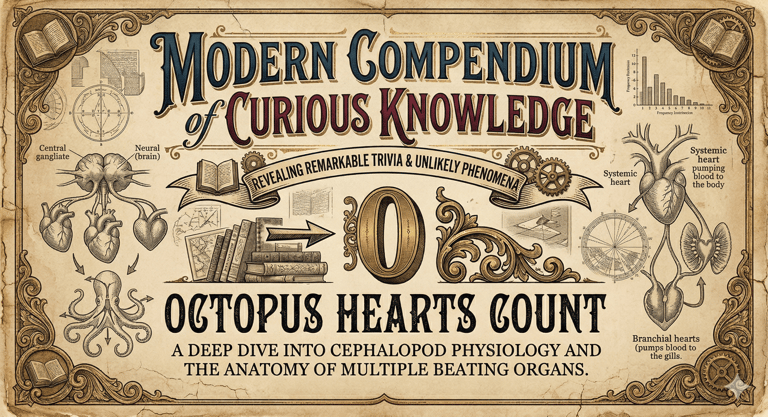
The octopus is a biological "over-achiever" when it comes to circulation. It possesses three separate hearts that work in a synchronized rhythm to move blue, copper-based blood through its highly active and complex body.
The Deep Dive
The "junk knowledge" behind the octopus's heart count is that they don't have three hearts because they are "extra loving," but because their blood is incredibly "thick" and difficult to move. Unlike humans, who use iron-based hemoglobin to carry oxygen (making our blood red), octopuses use a copper-based protein called hemocyanin.
The Systemic Heart: The largest of the three is the systemic heart. Its job is to pump blood throughout the entire body, delivering oxygen to the octopus’s eight arms and its highly developed brain.
The Branchial (Gill) Hearts: The two smaller hearts are located at the base of the gills. Their sole purpose is to pump deoxygenated blood through the gills to pick up oxygen from the seawater. This "boost" is necessary because hemocyanin is actually less efficient at carrying oxygen than hemoglobin, especially in cold or low-oxygen water.
The "Stop-Go" Problem: Here is the real "junk" of octopus biology: when an octopus swims, its systemic heart actually stops beating. The physical effort of jet propulsion puts so much pressure on the body that the main heart cannot overcome it. This is why octopuses prefer to "scuttle" or crawl along the seafloor—swimming is literally heart-stopping and exhausting for them.
The octopus heart reached peak "junk" status in the world of alien biology theories. It represents the "junk" of alternative evolution: a blueprint for life that solves the same problems we face (circulation and oxygenation) in a completely "alien" and decentralized way.
Fast Facts
The Blue Blood: Hemocyanin turns the blood a deep, translucent blue when oxygenated. When it loses its oxygen, the blood becomes clear.
Cold Water Specialists: Octopuses have a "junk" adaptation for the deep ocean: they can increase the concentration of hemocyanin in their blood to survive in near-freezing temperatures, though this makes the blood even thicker and harder for those three hearts to pump.
The "Brainy" Connection: Because the octopus has three hearts and a decentralized nervous system (where two-thirds of its neurons are in its arms), some scientists describe the octopus as a "group" rather than a single individual. Each arm can "think" and "react" even if the main brain is "sticking its nose in" something else.
References
Wells, M. J. (1962). Brain and Behaviour in Cephalopods. Stanford University Press.
Schmidt-Nielsen, K. (1997). Animal Physiology: Adaptation and Environment. Cambridge University Press.
The Marine Biological Laboratory. (2026). The Blue Bloods: Understanding Cephalopod Circulation.