Turn a Blind Eye
The Definition
To deliberately ignore a situation, a set of facts, or an obvious wrongdoing. It is the act of choosing not to "see" something that would otherwise require action or intervention.
The Deep Dive
This is one of the most famous examples of "junk knowledge" that is actually backed by a specific historical event. The phrase is attributed to one of Britain’s greatest naval heroes, Admiral Horatio Nelson, during the Battle of Copenhagen in 1801.
Nelson, who had lost the sight in his right eye during a previous battle in Corsica, was serving as second-in-command under Admiral Sir Hyde Parker. As the battle turned fierce and the Danish resistance proved stronger than expected, Parker—who was stationed further away and cautious—signaled for the fleet to withdraw.
The Signal: Parker hoisted Signal Number 39, which was the order to "discontinue the action."
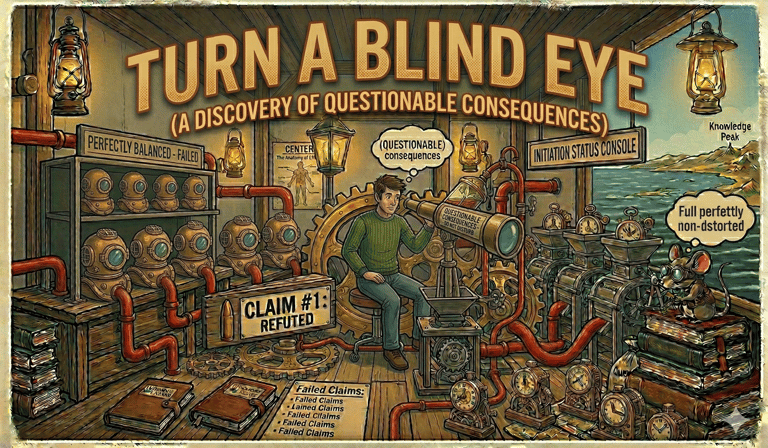
The Defiance: When Nelson’s signal lieutenant informed him of the order, Nelson allegedly lifted his telescope, pressed it against his blind eye, and remarked: "I have only one eye—I have a right to be blind sometimes... I really do not see the signal!"
Nelson ignored the order, continued the attack, and secured a decisive British victory. The phrase "turn a blind eye" moved from the deck of the HMS Elephant into common English parlance as a way to describe anyone who "looks away" from an inconvenient truth to achieve their own ends.
Fast Facts
The Irony: Had Nelson obeyed the signal and retreated, he likely would have been court-martialed for failure. By winning, his "blindness" was celebrated as a stroke of tactical genius.
The "Blind" Side: Nelson didn't actually wear an eye patch; he typically used a green silk shade attached to his hat to protect his remaining "good" eye from the sun.
The First Print: While the event happened in 1801, the specific phrase "turn a blind eye" didn't become a standard written idiom until the 1820's, after Nelson’s biographers had immortalized the story.
References
Southey, R. (1813). The Life of Nelson. John Murray.
Knight, R. (2005). The Pursuit of Victory: The Life and Achievement of Horatio Nelson. Basic Books.
Jeans, P. D. (2004). Ship to Shore: A Dictionary of Pictorial Maritime Grammar. McGraw-Hill.
The Oxford English Dictionary. (2026). Blind (adj. and n.). Oxford University Press.