Under the Weather
The Definition
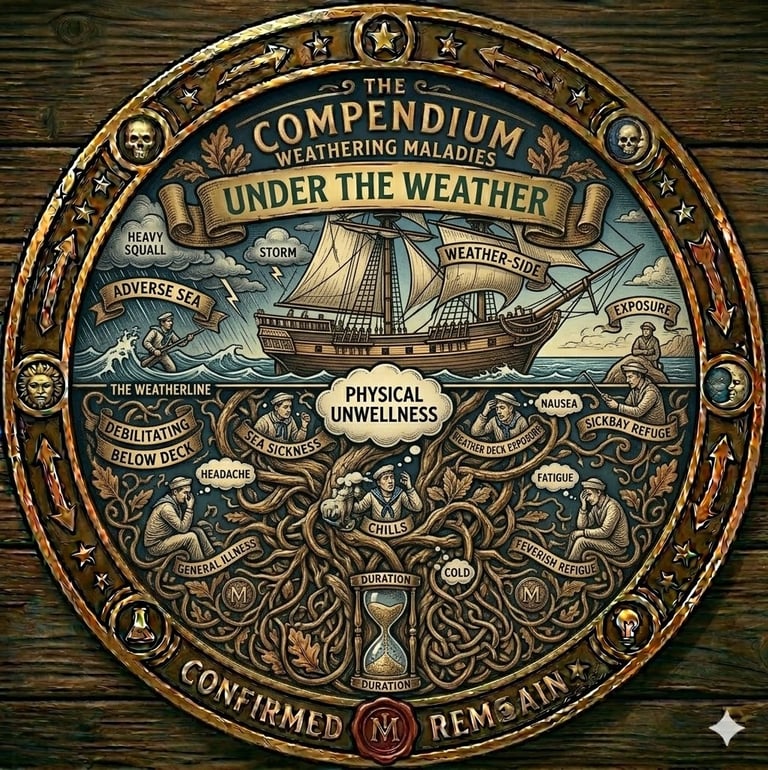
This idiom is used to describe feeling ill, tired, or otherwise indisposed. It typically refers to a state of being "unwell" that is not necessarily life-threatening but significant enough to hinder one's normal daily activity or energy levels.
The Deep Dive
The origins of this expression are found in the maritime history of the age of sail, where the physical environment of the open ocean directly dictated the health and stability of the crew.
Maritime Stability: In heavy seas, a ship would toss and roll violently. Sailors who became seasick or fell ill were sent below deck to the most stable part of the vessel, away from the wind and spray. By going below, they were literally positioned "under" the weather that was battering the ship’s exterior.
The Logbook Theory: A common "junk knowledge" theory suggests that on many ships, the "weather" side of the deck was where the sailors stood watch. If a sailor was too ill to perform his duties, his name was recorded in the ship's log under the column designated for weather conditions. Thus, the sailor was literally listed "under the weather."
Linguistic Migration: The phrase transitioned from a literal naval description to a general metaphor for poor health in the early 19th century. It represents a tall order of recovery; acknowledging that while the "storm" of the illness is present, it is often a temporary condition that will pass once the "skies" of one's health clear.
Fast Facts
The "Feeling Blue" Rival: While "under the weather" refers to physical health, "feeling blue" (also a maritime term related to flying a blue flag when a ship's captain died) refers primarily to emotional or mental sadness.
Global Weather Idioms: In many other languages, health is similarly tied to the atmosphere. In German, a person might say they are frösteln (chilly) to indicate they are coming down with an illness.
References
Ammer, C. (2013). The Dictionary of Clichés. Skyhorse Publishing.
Dana, R. H. (1840). Two Years Before the Mast.
Oxford English Dictionary. (2026). The Nautical Origins of Common Health Metaphors.