Unlucky Thirteen
The Definition
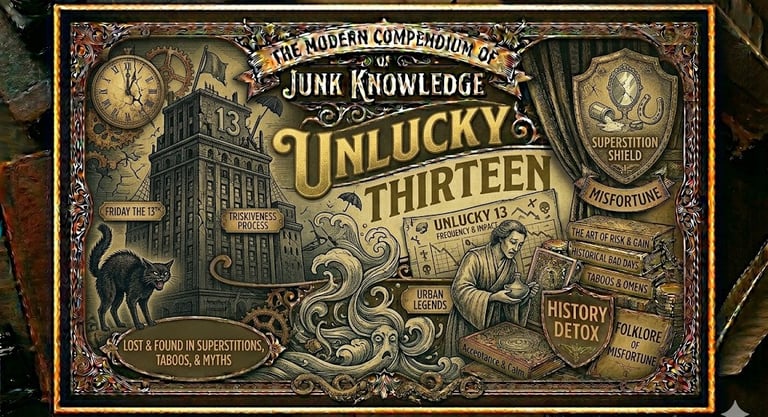
The cultural belief, primarily in Western societies, that the number 13 is an omen of bad luck, misfortune, or impending doom. This phenomenon is so widespread that it has its own clinical name: triskaidekaphobia. It is the ultimate "junk" superstition—a persistent piece of collective anxiety that influences everything from architecture to airline seating.
The Deep Dive
The "junk knowledge" behind the number 13 is that it isn't "unlucky" because of any mathematical property, but because it is the "intruder" that disrupts the perfection of the number 12.
The "Twelve" Obsession: In many ancient cultures, 12 was considered the number of cosmic completion: 12 months in a year, 12 signs of the zodiac, 12 hours on a clock, and 12 tribes of Israel. The number 13 is seen as "one too many"—a jagged, prime number that "sticks its nose in" where it isn't wanted, breaking the harmony of the dozen.
The Last Supper: Perhaps the most famous "junk" origin is the Biblical story of the Last Supper. There were 13 people at the table—Jesus and his 12 disciples. The 13th guest to arrive (or the one commonly identified as the betrayer) was Judas Iscariot. This cemented the superstition that having 13 people at a dinner party would lead to one of them "getting the axe" within a year.
The Norse Myth: A similar story exists in Norse mythology. At a banquet in Valhalla, 12 gods were enjoying a peaceful meal until the trickster god Loki arrived uninvited as the 13th guest. In the ensuing chaos, the beloved god Balder was killed.
The "Unlucky 13" reached peak "junk" status in the modern construction industry. It represents the "junk" of institutionalized fear: an estimated 85% of high-rise buildings in the U.S. do not have a floor labeled "13." They simply jump from 12 to 14, proving that even in the age of engineering and steel, we still "chicken out" when faced with a digit.
Fast Facts
Friday the 13th: This "double whammy" of bad luck combines the unlucky number with the unlucky day (Friday was traditionally the day of executions in Rome and the day of the Crucifixion). The fear of this specific date is called paraskevidekatriaphobia.
The "Thirteen Club": In the 1880's, Captain William Fowler started a club in New York to debunk the myth. They met on the 13th of every month in Room 13, sat 13 to a table, and spilled salt on purpose. Members included five U.S. Presidents, none of whom died immediately, yet the "junk" superstition survived them all.
The Apollo 13 "Coincidences": Skeptics of the myth were given a "close shave" in 1970. Apollo 13 was launched at 13:13 CST, from Pad 39 (a multiple of 13), and the oxygen tank exploded on April 13th. While the crew returned safely, it added a massive "load" of fuel to the superstitious fire.
References
Scanlon, T. J., et al. (1993). Is Friday the 13th Bad for Your Health? British Medical Journal.
Lachenmeyer, N. (2000). 13: The Story of the World's Most Popular Superstition.
The 13 Club Records. (1882-1920). Minutes of the New York Chapter.