Upper Crust
The Definition
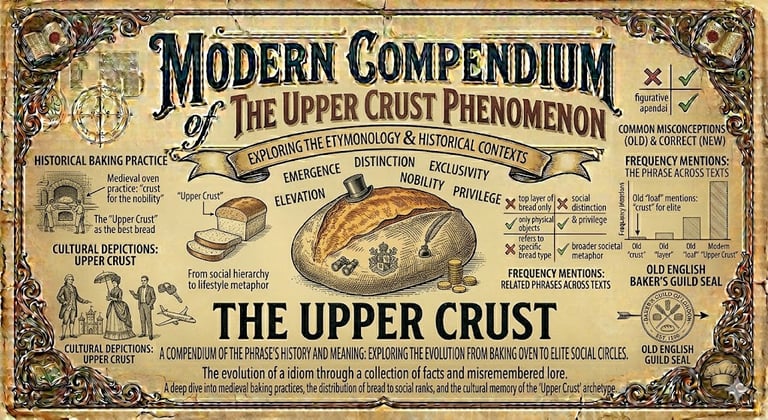
The highest social class; the elite or the aristocracy. It describes those at the top of the economic and social "loaf," implying that they are the most desirable, refined, and visible part of the community.
The Deep Dive
This is a "high-carb" piece of junk knowledge that traces back to the literal, physical anatomy of a 15th-century loaf of bread. Before modern industrial ovens provided even, consistent heat, baking a large loaf of bread in a wood-fired stone oven was a game of temperature extremes.
The "Ashy" Bottom: In a medieval oven, the bottom of the bread sat directly on the stone hearth. It was frequently scorched, covered in soot, or embedded with bits of ash and stone. This was the "lower crust"—edible, but tough and dirty.
The "Golden" Top: Heat rises, and the top of the loaf is baked by the circulating air. This resulted in a "crust" that was golden, crisp, and clean of debris.
The "Squire" Standard: According to the Boke of Curtasye (a 1460 manual on etiquette), the "upper crust" of the loaf was to be sliced off and presented specifically to the lord of the manor or the highest-ranking guest at the table. To be served the "upper crust" was a literal sign that you were the most important person in the room.
While the practice of serving the top of the bread to the elite is centuries old, the phrase didn't become a popular slang term for the people themselves until the 1820's. It was popularized by the British "dandy" culture and later by American writers like Mark Twain, who used it to poke fun at the self-importance of the wealthy "crust" of society.
Fast Facts
The "Crusty" Contrast: While the "upper crust" is the elite, a "crusty" person (referring to someone irritable or stuck-up) likely comes from the same root—someone whose exterior has become hard and difficult to penetrate.
The "Bread-Winner" Link: This is a linguistic cousin. While the "upper crust" eats the best part, the "bread-winner" is the one providing the loaf in the first place.
The First Print: The Boke of Curtasye (1460) explicitly instructs: "The kerver [carver] schalle kerve the vpper crust [for his lord]."
References
The Boke of Curtasye. (c. 1460). Sloane MS 1986, British Museum.
Twain, M. (1892). The American Claimant. (On the 'upper-crust' of the gentry).
Ammer, C. (2013). The Dictionary of Clichés. Skyhorse Publishing.
The Oxford English Dictionary. (2026). Crust (n.1). Oxford University Press.