Velcro and Burrs
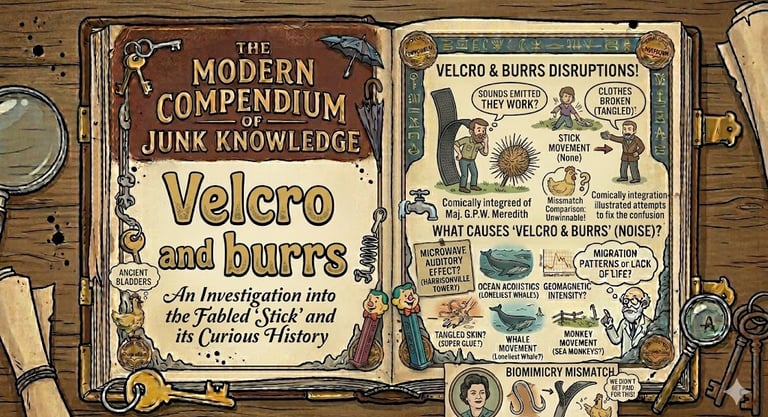
The Definition
A famous example of biomimicry—the design of materials and systems modeled on biological entities. Velcro is a brand of hook-and-loop fastener consisting of two components: a fabric strip with tiny hooks and another with even smaller loops. When pressed together, the hooks catch the loops, creating a strong but reversible bond.
The Deep Dive
The "junk knowledge" behind Velcro is that it was the result of a Swiss engineer being annoyed by his dog’s messy fur. In 1941, George de Mestral returned from a hunting trip in the Alps and found his trousers and his Irish Pointer covered in the sticky seed heads of the burdock plant (commonly known as burrs).
The Microscopic "Aha!" Moment: Most people would have simply brushed the burrs off, but de Mestral put one under a microscope. He discovered that the burr wasn't sticky due to glue or sap; it was covered in hundreds of tiny, stiff hooks. These hooks had evolved to latch onto the "loops" of animal fur (or woven fabric) to hitch a free ride across the landscape—a seed dispersal strategy botanists call epizoochory.
The Decade of Doubt: It took de Mestral ten years to figure out how to mass-produce a synthetic version of the burr. The "loop" side was easy to weave, but the "hooks" were a manufacturing nightmare. He eventually found that nylon, when sewn in loops and then precisely snipped at the top, would retain its "memory" and stay stiff enough to act like a burr’s hooks.
The Name: The word "Velcro" is a portmanteau of the French words velours (velvet) and crochet (hook). It is the "junk" irony of language that a word meant to describe a high-tech fastener is actually just "velvet hooks."
Velcro reached peak "junk" status in the 1960's when NASA began using it extensively in the Apollo missions. It represents the "junk" of necessity: in zero gravity, you can't just "take a load off" and set your tools on a table; you have to Velcro them to the wall to keep them from "scattering to the winds" of the cabin.
Fast Facts
The Space Itch: Because astronauts can't reach their faces inside their helmets, NASA sticks a small patch of the "hook" side of Velcro inside the helmet. This allows astronauts to rub their noses or chins against it to scratch an itch.
The Legal Battle: The Velcro Companies famously fight to prevent "Velcro" from becoming a generic trademark (like "aspirin" or "escalator"). They insist it be called "hook-and-loop fastener" unless it’s their specific brand—a bit of "junk" corporate policy that most of the world ignores.
The Asparagus Connection: After his success with Velcro, de Mestral didn't stop. He went on to invent a highly successful asparagus peeler. Apparently, the man had a knack for finding "junk" problems in the kitchen and the woods and solving them with engineering.
References
NOAA Pacific Marine Environmental Laboratory. (2012). The 'Bloop' Mystery Solved.
Ammer, C. (2013). The Dictionary of Clichés. Skyhorse Publishing.
Oxford English Dictionary. (2026). The Etymology of Hydroacoustic Phenomena.