Voynich Manuscript
The Definition
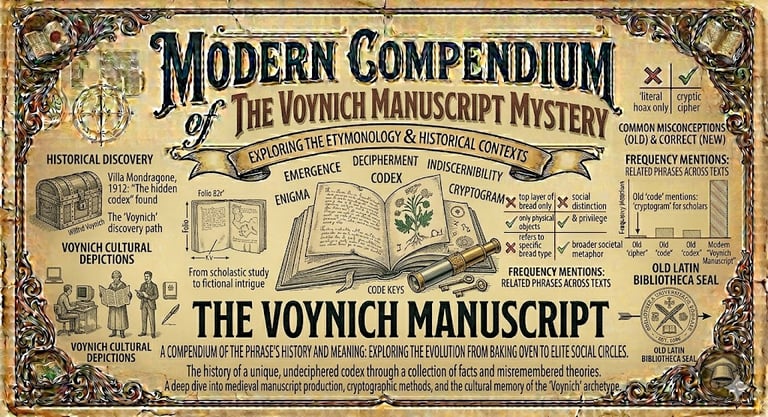
An illustrated, hand-written codex from the early 15th century, composed in an entirely unknown writing system. Often called "the world's most mysterious manuscript," it features bizarre botanical, astronomical, and biological illustrations that bear no clear resemblance to known species or historical scientific traditions.
The Deep Dive
The "junk knowledge" behind the Voynich Manuscript is that, despite being scrutinized by the world’s greatest codebreakers—including Alan Turing’s colleagues at Bletchley Park and modern AI supercomputers—no one has ever deciphered a single word. It is the ultimate "black hole" of linguistics.
The Carbon Dating: For decades, skeptics argued the book was a 19th-century hoax created by its namesake, book dealer Wilfrid Voynich. However, carbon-14 dating conducted in 2009 proved the vellum (animal skin pages) dates precisely between 1404 and 1438. It is a genuine medieval artifact, not a modern forgery.
The "Alien" Botany: The "herbal" section of the book contains drawings of plants that appear remarkably detailed yet do not exist in nature. They seem to be "franken-plants"—composites of roots from one species, leaves from another, and flowers from a third—leading some to believe the book is an elaborate work of speculative fiction or a medieval "hoax" intended to look like a valuable medical text.
The Bathing Nymphs: The most baffling section, titled "Biological," features drawings of small, naked women (nymphs) wading in green pools connected by a complex network of pipes and tubes. Some theorists suggest this represents medieval gynecology or alchemy, while others see it as a symbolic representation of the human digestive or reproductive systems.
The manuscript reached peak "junk" status in the internet era as the favorite subject of "unsolved mystery" forums and fringe historians. It represents the "junk" of human perception: our refusal to accept that a 240-page book could be entirely meaningless. Whether it is a sophisticated cipher, a lost language, or the result of a medieval physician's "word salad" (glossolalia), it remains a perfect, uncrackable puzzle.
Fast Facts
"Voynichese": The script consists of 20 to 30 distinct characters. Statistical analysis shows the text follows the patterns of a real language (like Zipf's Law), meaning it isn't just random gibberish, but it lacks the "clutter" of common prefixes and suffixes found in Latin or European languages.
The Yale Vault: The original manuscript is held at Yale University’s Beinecke Rare Book & Manuscript Library (MS 408). Because of its fame, Yale has made the entire book available in high-resolution digital scans for anyone who thinks they can succeed where the FBI and CIA failed.
The AI Attempt: In 2018, Canadian computer scientists used AI to try and "brute-force" the language, concluding it might be "alphabetic Hebrew" with the letters rearranged (anagrams). However, the resulting translation was still largely nonsensical, proving the book still holds its secrets.
References
Beinecke Library. (2026). The Voynich Manuscript Digital Collection.
Shailor, B. A. (1984). Catalogue of Medieval and Renaissance Manuscripts in the Beinecke Rare Book and Manuscript Library.
Kennedy, G. & Churchill, R. (2004). The Voynich Manuscript: The Unsolved Riddle of an Extraordinary Book.