WD-40
The Definition
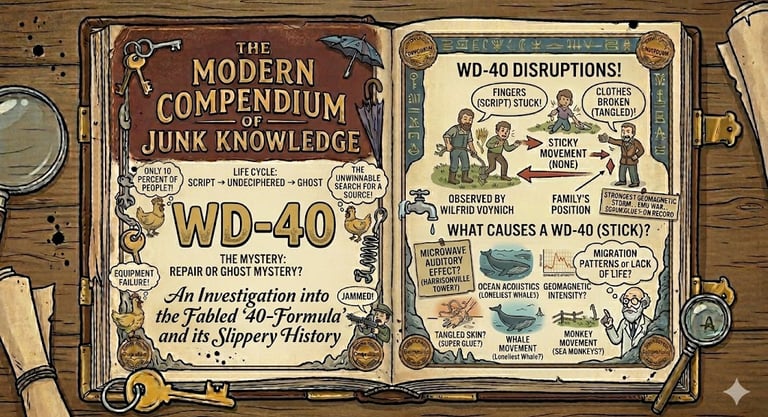
A ubiquitous, blue-and-yellow-canned penetrating oil and water-displacing spray. While technically designed to prevent corrosion and displace moisture, it has become the "universal solvent" of the modern household—used for everything from silencing squeaky hinges and loosening rusted bolts to removing sticker residue and, in some cases, deterring garden pests.
The Deep Dive
The "junk knowledge" behind WD-40 is baked directly into its name. It is the ultimate testament to the "try, try again" school of engineering. It was never intended for your garage; it was a cold-war chemical shield designed for the Convair SM-65 Atlas missile.
Water Displacement: "WD-40" stands for "Water Displacement, 40th Formula." In 1953, the Rocket Chemical Company and its staff of three were tasked with creating a line of rust-prevention solvents and degreasers for use in the aerospace industry. It took them 39 failed attempts to get the chemical balance of the solvent exactly right.
The Missile Skin: The Atlas missile used extremely thin stainless steel "balloons" as fuel tanks, which were prone to rust and corrosion while sitting on the launch pad. WD-40 was sprayed on the outer skin of these nuclear-capable missiles to protect them from the elements.
The "Lunchbox" Heist: The product was so effective that employees at Convair began sneaking it home in their lunchboxes to use on their own cars and household repairs. Recognizing the massive consumer potential, the company president, Norm Larsen, began packaging WD-40 in aerosol cans for the general public in 1958.
WD-40 reached peak "junk" status in the late 20th century as one half of the "Grand Unified Theory of Home Repair" (the other half being Duct Tape). It represents the "junk" of chemical secrets: despite being in millions of homes, the exact formula of WD-40 is not patented—to avoid revealing the ingredients—and is kept in a bank vault in San Diego.
Fast Facts
Not a Lubricant: One of the most common pieces of "junk" misinformation is that WD-40 is a long-term lubricant. It is a solvent and a penetrant. While it provides short-term lubrication, it eventually evaporates and can actually wash away heavier, more effective greases (like those on bicycle chains).
The "Fish Oil" Myth: A persistent urban legend claims that WD-40 is primarily made of fish oil. The company officially denies this, stating the product is petroleum-based; however, the myth is so strong that some fishermen still spray it on their lures to attract fish (a practice the company does not recommend).
The Stink of Success: The distinctive smell of WD-40 is almost as iconic as its can. In the 1960's, the company experimented with adding fragrance to make it more "pleasant," but the public revolted, preferring the "industrial" smell they associated with efficacy.
References
WD-40 Company Archives. (2026). The Atlas Missile Legacy.
Petroski, H. (1992). The Evolution of Useful Things. Alfred A. Knopf.
The San Diego Union-Tribune. (2015). Norm Larsen: The Man Behind the 40th Formula.