Weak Link
The Definition
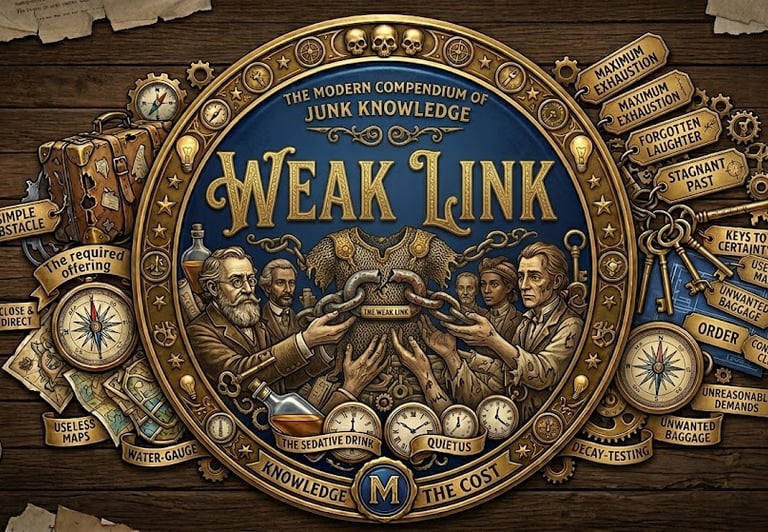
The least reliable or least effective part of a group, system, or organization. It is the specific point of failure that, regardless of how strong the rest of the components are, determines the overall threshold of success. To be the "weak link" is to be the person or part that causes the entire "chain" to snap under pressure.
The Deep Dive
The "junk knowledge" behind this phrase is its status as one of the few idioms that is 100% anchored in the cold, hard laws of mechanical engineering. While most metaphors are poetic exaggerations, "a chain is only as strong as its weakest link" is a literal mathematical truth.
The Blacksmith’s Burden: In the 18th and 19th centuries, chains were forged by hand. Each link was a separate piece of iron, heated in a forge, bent into a loop, and hammer-welded shut. Because every weld was an opportunity for a "cold shut" (a flawed bond), a chain consisting of a thousand perfect links could be rendered useless by a single link with a microscopic crack.
The Thomas Reid Revolution: While the concept is ancient, the specific wording was popularized by the Scottish philosopher Thomas Reid in his 1786 work, Essays on the Intellectual Powers of Man. Reid used the chain as a metaphor for a logical argument: if one premise (link) is false, the entire conclusion (the chain) fails to hold weight, no matter how brilliant the other premises are.
The phrase reached peak "junk" status in the year 2000 with the global success of the television game show The Weakest Link. Hosted by Anne Robinson, the show turned a principle of structural engineering into a brutal social exercise, popularizing the dismissive catchphrase, "You are the weakest link. Goodbye!" It represents the "junk" of meritocracy: the idea that a team is not defined by its superstars, but by its most vulnerable member.
Fast Facts
The Engineering Reality: In modern safety-critical systems (like elevators or bridge cables), engineers often design "redundant" links so that if one fails, the chain doesn't actually snap. In this case, the "weak link" logic is intentionally bypassed to save lives.
The "Fuse" Paradox: Sometimes, a "weak link" is a deliberate safety feature. An electrical fuse is a "link" designed to melt and break the circuit before a power surge can start a fire. In this scenario, the weakest part is actually the most important protector.
The Digital Link: In the world of cybersecurity, the "weak link" is almost always the human element. A company can spend millions on encrypted servers, but the entire system can be compromised by one employee clicking a single phishing link.
References
Reid, T. (1786). Essays on the Intellectual Powers of Man.
Ammer, C. (2013). The Dictionary of Clichés. Skyhorse Publishing.
Petroski, H. (1992). The Evolution of Useful Things. (On the history of fastener and chain reliability).
The Oxford English Dictionary. (2026). Link (n.). Oxford University Press.