Weimar Reality
The Definition
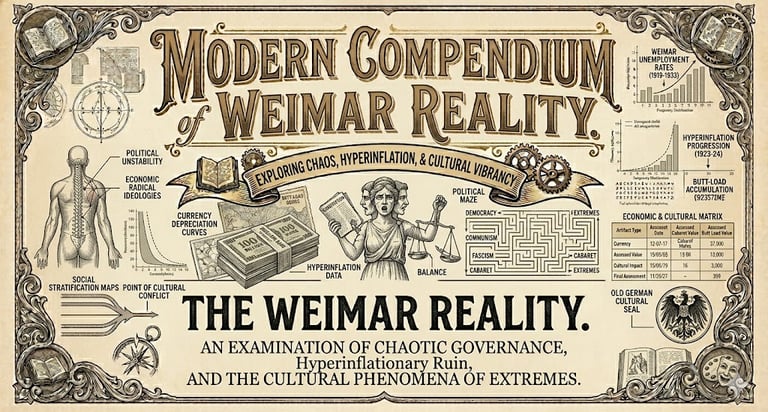
As a modern socio-economic metaphor, "Weimar reality" describes a state of profound societal instability where traditional structures of trust, currency, and authority have completely fractured. It signifies an environment characterized by two stark, simultaneous extremes: severe economic anxiety and institutional paralysis on one hand, running parallel to an explosion of manic, cutting-edge cultural experimentation, cynicism, and dark humor on the other.
The Deep Dive
The phrase is an unvarnished historical callback to Germany's Weimar Republic (1918–1933)—the fragile, chaotic democratic state wedged between the collapse of the German Empire after World War I and the rise of the totalitarian Third Reich.
The Psychology of Instability: For the citizens living through it, Weimar reality meant navigating a world where the unwritten rules of daily life changed on a weekly basis. Born out of the national trauma of a lost war and a punitive peace treaty (Versailles), the republic was plagued by political assassinations, constant parliamentary gridlock, and the complete vaporization of the middle class's life savings during the hyperinflation crisis of 1923.
The Death of Permanence: When a currency drops so fast that workers demand to be paid twice a day just to buy a loaf of bread before the price doubles, the human relationship with the future changes fundamentally. Long-term planning, conservative asset management, and traditional bourgeois thrift were exposed as illusions. In their place emerged a raw, living-for-the-moment philosophy.
The Creative Explosion: Because the old imperial censorship laws had been dismantled, the vacuum left by the collapsing social order was instantly filled by an unparalleled wave of creative boldness. Berlin became the avant-garde capital of the world. Artists, filmmakers, and playwrights rejected standard romanticism and looked at the world with a detached, cold, and cynical perspective known as Neue Sachlichkeit (New Objectivity).
The Cinematic Pioneers: Filmmakers turned to German Expressionism (evident in masterpieces like The Cabinet of Dr. Caligari and Metropolis), using distorted, geometrically absurd sets and deep, jagged shadows to mirror the psychological madness and anxiety of the population.
The Satirical Shield: In nightlife, the politicized cabaret scene transformed dark irony and savage sarcasm into a premier defensive shield against despair, mocking the very politicians who were failing to keep the streets safe.
The Contemporary Metaphor
In modern geopolitical and cultural commentary, analysts invoke "Weimar reality" as a stark warning sign for contemporary democratic societies experiencing extreme polarization. When a commentator remarks that a modern industry, city, or political landscape is taking on a Weimar reality, they are noting that beneath a veneer of hyper-modern, frantic creative activity, the underlying foundational architecture is running on borrowed time.
Fast Facts
The "I am a Camera" Posture: The signature literary description of Weimar reality belongs to author Christopher Isherwood in his 1935 Berlin Stories (the basis for the musical Cabaret), where he famously wrote: "I am a camera with its shutter open, quite passive, recording, not thinking." This captured the detached, surgical observation style favored by intellectuals trying to process the chaos surrounding them.
The Golden Era Mirage: Historians note that the republic did enjoy a brief "stabilized period" between 1924 and 1929, fueled by massive loans from American bankers. However, this stability was exposed as a complete mirage the instant the U.S. stock market crashed in late 1929, dragging Germany right back down into economic ruin.
References
Gay, P. (1968). Weimar Culture: The Outsider as Insider. Harper & Row. (The definitive text on the intellectual and artistic anxieties of the era).
Isherwood, C. (1935). Goodbye to Berlin. Hogarth Press.
Oxford English Dictionary. (2026). The Metaphorical Integration of Interwar Macro-Economic Fractures and Avant-Garde Artistic Nomenclature.